+971 50 217 6793 Abu Dhabi, UAE info@lifeguarddatarecovery.com

how long does hard drive data recovery take
How Long Does Hard Drive Data Recovery Take When a hard drive suddenly crashes, it feels like time just stops. Whether you are running a business and watching your main server go down, a creative designer who lost their whole portfolio, or just someone who realized all their family photos are gone, the panic is real.
lifeguard datarecovery You just want your files back, and you want to know exactly when you’re gonna get them.This isn’t because the labs are trying to be slow or make the bill higher. The time it takes really depends on how hard drives are built, how complicated modern disks are, and the careful steps an engineer has to take to pull data safely from broken parts.
Let’s look at how things actually work inside a data recovery lab. This way, you don’t fall for those “24-hour miracle” ads, and you can understand what’s really happening with your drive.
File Corruption & Accidental Deletion (Logical Damage)
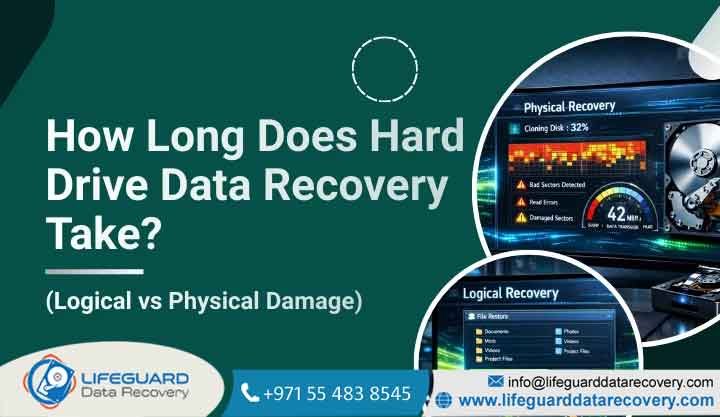
Logical damage means the inside parts of your drive are perfectly fine. The internal motor spins smoothly, the little heads read data accurately, and the green circuit board works fine. The only problem is that the software side the way files are organized is broken or messy.
This usually happens when You accidentally format the drive or delete a partition. The system crashes or turns off suddenly, making the drive show up as RAW or unallocated space. Windows or Mac updates get interrupted halfway. A virus locks up your files.
Since the hardware is still working normally, engineers don’t need to open the drive or look for replacement parts. Because of this, the data recovery process time is pretty short. It mostly depends on how big your drive is and if you wrote new files over the old ones after the accident.
Mechanical Crashes & Broken Components (Physical Damage)
Physical damage means something is actually broken inside the drive. Maybe you dropped your external drive off the table, or there was a sudden power trip at home. Sometimes, parts just get old and die.
You can usually tell it’s physical if you notice:
A clicking noise that keeps repeating (many call it the “Click of Death”).
A weak beeping sound when you plug it into your laptop.
The drive doesn’t spin at all and stays completely quiet and cold.
Your computer completely freezes up the moment you plug it in.
When things are physically broken, software can’t fix it. The drive must be opened inside a very clean room (an ISO Class 5 cleanroom bench) so no dust gets on the platters. Finding matching donor parts and fixing the delicate insides is why how long does HDD recovery take can stretch out for days.
Real-World Benchmarks: Average Hard Drive Data Recovery Time By Scenario
To give you a better idea of what to expect, professional labs usually divide their work into three levels.
Accidental Deletion & Formatted Drives
When you delete a folder by mistake, your computer doesn’t actually wipe the data right away. It just deletes the index entry and marks that spot as “empty space” where new files can be written.
If you stop using the drive immediately, those files are still sitting there. Labs use special software to scan the deep parts of the drive. Usually, an engineer can find and recover deleted files within a few hours or a single day.
Unrecognized, Corrupted, or RAW File Systems
In this situation, your drive spins fine without making scary sounds, but your computer freezes up or says, “You need to format the disk before using it.” This usually means the drive has a lot of “bad sectors” (damaged areas on the disk) or the internal firmware is confused.
To handle this safely, labs use expensive hardware tools like the . These tools let engineers control the power and read the drive slowly, skipping the bad parts. The hard disk recovery time here involves making a safe clone of your data before the drive gets any worse.
Clicking, Beeping, or Dead Hard Drives
When the tiny read/write heads inside fail, they can drop directly onto the smooth spinning platters. This causes a lot of friction, which stops the motor (making that faint beeping sound) or makes the heads swing wildly back and forth (the clicking sound).
To recover files from crashed hard drive parts, an engineer has to find an exact matching “donor” drive, take its healthy heads out, and put them into your broken drive. This takes a lot of steady handwork. If the parts are rare and need to be shipped from overseas, your average hard drive data recovery time will easily take a week or two.
Hidden Critical Factors That Dictate Your HDD Data Recovery Turnaround Time
There are a few other reasons why your HDD data recovery turnaround time might take longer than expected.
1. Drive Capacity and Physical Read Speeds
A big drive simply takes longer to read. Brand new drives can read data fast when healthy, but when a drive is dying, the lab equipment has to slow down a lot sometimes to a crawl just to keep the drive from dying completely. Cloning a damaged 10TB drive takes way longer than an old 500GB laptop drive, which changes how long does it take to recover data from a hard drive.
2. Sourcing Rare Donor Components for Head Swaps
You can’t just buy any random drive from the shop and use its parts. To fix a broken head assembly, the donor drive must match your drive perfectly. We are talking about matching the country it was made in (like Thailand vs China), the date of manufacture, and even specific internal microcodes. If the lab doesn’t have this exact match in their inventory, you have to wait until they find one online and ship it in.
3. Modern Drive Technologies (SMR vs. CMR)
If you bought your drive recently, it might use a technology called Shingled Magnetic Recording (SMR). This is where data tracks overlap each other like roof tiles to save space. While it saves money, it makes recovery a nightmare. When an SMR drive crashes, its internal translator layer often breaks down, making the files invisible. Fixing this takes deep engineering work, which adds a few days to the timeline.
4. The Severity of Platter Scratches and Degradation
If a broken head scratches the smooth surface of the platter inside, it leaves rings of damage. Data on those scratched areas is usually gone forever. To save what’s left, engineers have to program their tools to skip the bad parts and read the healthy tracks backward. This slows down the whole process by a lot.
5. Service Level: Standard vs. Emergency Track
Just like going to a doctor, your place in the queue matters. With standard service, your drive waits its turn behind other cases. But if a business loses critical server data, they can pay for an emergency hard drive data recovery service. This gets the drive onto an engineer’s desk immediately, cutting the hard drive recovery turnaround for businesses down to just 24 to 48 hours.
The Technical Step-by-Step Data Recovery Process Timeline
Here is a quick look at the journey your drive goes through once you hand it over to a lab:
In-Lab Evaluation & Safety Assessment
First, engineers check the drive’s circuit board for electrical shorts. Then, they connect it to diagnostic tools to check if the internal heads are working without forcing the drive to open up in a regular operating system, which could damage it further.
Mechanical Stabilization & Firmware Repair
If the hardware is okay but the internal software (firmware) is broken, the engineer has to manually fix the drive’s internal system files so it can start working normally again. How long this takes depends heavily on the model of the drive.
Sector-by-Sector Write-Blocked Cloning
A proper hard drive recovery service will never try to scan your original, fragile drive directly. Instead, they connect it to a special imager that blocks any data from writing onto your drive. Then, they carefully copy every single sector onto a healthy drive to make an exact clone.
File Structure Extraction & Quality Verification
Once they have the clone, they put your old drive away safely. Then, they use data recovery tools on the clone to rebuild the folder structures, fix broken files, and check that everything actually opens properly.
Crucial Preservation Tips How to Avoid Extending Your Recovery Time
If your drive is starting to fail, what you do in the next few minutes can mean the difference between a successful recovery or losing everything forever.
Stop Powering It Up: If your drive is making clicking or scraping sounds, every time you turn it on, the broken heads are scratching the inside discs, destroying your data forever. Unplug it immediately.
Don’t Use Free Software on Clicking Drives: Data recovery software is only for healthy drives with missing files. Running software on a physically broken drive forces it to work too hard, causing it to die completely.
Forget the “Freezer Trick”: Old internet advice says to put your drive in the freezer or open it up at home. Freezing creates moisture inside that ruins the surface when it warms up. And opening it outside a proper clean room allows dust to land on the platters, destroying the drive heads instantly.
Hard Drive Recovery Frequently Asked Questions (FAQ)
Can I get same day hard drive data recovery?
Yes, but usually only for simple issues, like if you accidentally deleted a file or if the external casing broke but the internal drive is completely healthy. For physical damage or clicking drives, it’s almost impossible to finish in one day.
Does a larger hard drive take longer to recover?
Yes, definitely. Hard drives have physical limits on how fast they can read data. A large 16TB drive simply has a lot more areas to check and clone than an old 1TB drive, especially if there are bad sectors.
How do I choose between software and file recovery services?
A simple rule: if your drive is making weird clicking noises, doesn’t spin, or isn’t even detected by your computer’s black boot screen (BIOS), software cannot help you. You will need a proper professional hard drive data recovery lab. Only use software if the drive works perfectly fine but you just can’t find a folder.