+971 50 217 6793 Abu Dhabi, UAE info@lifeguarddatarecovery.com
Why do SSDs fail without warning?
Why Do SSDs Fail Without Warning (Causes, Symptoms, & What to Do) Unlike traditional mechanical Hard Disk Drives (HDDs) that broadcast their impending death through audible clicking, metallic grinding, or gradual bad sector accumulation, Solid-State Drives (SSDs) frequently stop working instantly without a single warning sign.
lifeguard datrecovery One moment your desktop or laptop system is running smoothly; the next, you face a Blue Screen of Death (BSOD), a kernel panic, a missing boot device error, or an unreadable, uninitialized RAW partition.
Understanding the electronic architecture of flash storage specifically why SSDs die silently, how to spot subtle warning signs before total failure, and how to safely troubleshoot or recover data from an unresponsive drive—is essential for avoiding catastrophic data loss.
Mechanical HDDs vs. SSDs Why SSD Failure Is Silent
To understand why solid-state drives fail without warning, you must first contrast them with legacy magnetic storage technology.
Traditional hard disk drives rely on physical, moving mechanical components: high-speed electric spindle motors, magnetic aluminum or glass platters spinning at 5,400 to 15,000 RPM, and ultra-precise read/write head actuator arms hovering nanometers above the platter surfaces. When these mechanical parts degrade over time, physical wear generates clear, audible warning signs:
Mechanical clicking (“click of death”) caused by the actuator arm hitting its physical stops due to tracking failure.
High-pitched whining or grinding caused by worn spindle bearings.
Slower file access and read/write timeouts as the drive controller repeatedly retries reading magnetically degraded sectors.
SSDs, on the other hand, are purely electronic, solid-state semiconductor devices. They contain zero moving parts. Instead of magnetic platters, an SSD relies on integrated circuit boards containing three core components:
The SSD Controller: A specialized multi-core ARM or proprietary microprocessor that acts as the brain of the drive, executing low-level firmware instructions, managing host communications, and performing wear leveling.
DRAM Cache (Optional): High-speed volatile memory used by the controller to store host mapping tables and speed up lookup operations.
Because there are no mechanical parts to grind down or wobble, an SSD does not give physical audio cues. Failure in an SSD occurs at the micro-electronic layer—such as a short-circuited capacitor, an integrated circuit silicon fault, or corrupted internal firmware mapping tables. When an electronic circuit or software mapping index fails, communication between the host system and the drive stops instantaneously.
Primary SSD Failure Causes: Why Drives Fail Instantly
When an SSD suddenly stops working, the root cause usually lies within one of four critical hardware, firmware, or electrical layers.
SSD Controller Failure & FTL Corruption
The SSD Controller is the single most critical component on the drive. It executes complex algorithms to make high-density, inherently unreliable NAND flash appear as a fast, seamless block device to your operating system.
To route incoming host read/write commands to the correct physical NAND memory cells, the controller maintains an internal lookup database called the Flash Translation Layer (FTL) mapping table. The FTL map translates Logical Block Addresses (LBAs) supplied by the operating system into physical page and block addresses on the flash chips.
Controller Hardware Failure: The controller is an active CPU that runs at high speeds and generates substantial operational heat. If its internal logic gates fail due to thermal fatigue, electromigration, or electrical overstress, the drive loses its ability to communicate across the PCIe/SATA bus. The drive instantly becomes completely undetectable in BIOS/UEFI.
FTL Table Corruption: The FTL mapping table is constantly updated during write cycles and background maintenance operations. If an ungraceful shutdown or voltage drop interrupts an FTL update, the lookup table can become corrupted or mismatched. Without a functional FTL table, the controller no longer knows where files physically reside. Even if the underlying NAND flash chips contain intact data, the drive will present itself to the host system as completely uninitialized, show a total capacity of 0 Bytes, or refuse to mount.
NAND Flash Failure & Read/Write Exhaustion
NAND flash memory stores binary data by trapping electrons inside microscopic memory cells. Every write or erase operation requires applying a voltage pulse across an oxide insulation layer to inject or remove electrons.
Endurance Limits & TBW: Over time, these repeated electrical high-voltage pulses physically degrade the dielectric oxide insulator. Drive manufacturers measure this endurance limit using Total Bytes Written (TBW) or Program/Erase (P/E) cycles. As the oxide layer breaks down, memory cells lose their ability to reliably hold electrical charges, leading to bit errors that exceed the controller’s Error Correction Code (ECC) recovery thresholds.
System Metadata Block Burnout: While wear-leveling algorithms attempt to distribute write operations evenly across the entire memory array, specific system blocks such as those housing controller boot code, defect management tables, and event logs suffer higher rewrite frequencies. If these critical internal metadata sectors reach cell exhaustion, the controller locks down the drive into a permanent read-only state or halts execution entirely to prevent further corruption.
SSD Firmware Corruption & Abrupt Power Loss
SSD firmware is the embedded low-level code that runs directly on the controller. It manages sophisticated storage routines, including wear-leveling distribution, background garbage collection, bad-block retirement, and active thermal management.
Ungraceful Power Shutdowns: If a desktop PC loses power unexpectedly, or if a laptop battery dies while the controller is actively modifying firmware state logs or executing background garbage collection, the firmware state flags can become corrupted.
Diagnostic Panic Loops: Upon the next power-on cycle, the controller boots its embedded ROM code, detects an inconsistent internal state or checksum failure, and enters a fail-safe diagnostic state known as “Panic Mode.” When in Panic Mode, the drive halts standard host communications and identifies itself in system BIOS under generic internal manufacturer engineering names
SSD Overheating & Thermal Throttling Breakdown
Modern M.2 NVMe SSDs utilize ultra-fast PCIe Gen 4 and Gen 5 interface buses capable of data transfer speeds. At these high transfer rates, the SSD controller and power management ICs (PMICs) generate extreme heat.
Solder Joint Expansion: Operating at sustained high temperatures above 70°C to 85°C causes significant thermal expansion across the Printed Circuit Board (PCB). Over hundreds of heating and cooling cycles, this thermal stress can cause micro-cracks in surface-mount solder joints, severing electrical conductivity between the controller, DRAM, and NAND packages.
Thermal Shutdown Triggers: While modern controllers feature internal thermal throttling mechanisms designed to drop performance when temperatures spike, severe thermal runaway can trigger an instantaneous emergency shutdown of the drive controller to protect the physical silicon from permanent burning, dropping the drive offline mid-operation.
Subtle Signs of SSD Failure Before a Total Shutdown
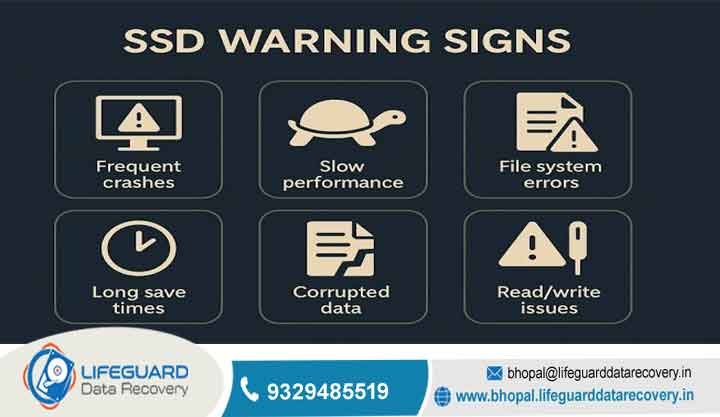
While sudden SSD failures frequently occur without advance S.M.A.R.T. warning flags, drives sometimes display subtle operational anomalies prior to a complete crash. Recognizing these early warning signs allows you to back up your data before the controller locks down permanently.
Troubleshooting: What to Do When an SSD Suddenly Stops Working
If your SSD becomes unresponsive, drops offline, or is not detected by your operating system, do not panic or attempt destructive formatting steps. Follow this logical, non-destructive diagnostic process to identify whether the issue is a temporary controller hang, a configuration error, or a permanent hardware failure.
Perform Physical Connections Checks & The 30-Minute Power Cycle
An unexpected system power loss or electrical glitch can leave an SSD controller stuck in a firmware loop or waiting to repair a mismatched FTL state flag. Performing a dedicated power cycle provides uninterrupted standby power to the drive controller, allowing its internal self-repair routines to complete
The TRIM Command & Background Garbage Collection
In modern operating systems (Windows 7+, macOS 10.6+, Linux), whenever a file is deleted, a partition is removed, or a drive is formatted, the OS sends an internal instruction called the TRIM command down to the storage controller.
Why TRIM Exists: NAND flash cells cannot overwrite existing data directly; they must be completely erased before new data can be written. TRIM informs the controller which Logical Block Addresses (LBAs) contain deleted data, allowing the controller’s background garbage collection thread to erase those physical pages ahead of time.
The Recovery Barrier: Once a TRIM command executes, the controller unlinks the LBA mappings and resets those memory addresses to return zeroes to any subsequent read request. Even if the physical electrical charge still briefly exists on the NAND floating gates, standard file recovery software will only read empty strings of zero.
When Software Recovery Is Safe & Possible
Software recovery tools (such as R-Studio, DMDE, or EaseUS) can only successfully recover files if all of the following conditions are met:
The SSD hardware is fully functional and consistently detected in BIOS and Disk Management with its correct capacity.
The failure is strictly logical (e.g., accidental partition deletion, file system header corruption, or a corrupted volume table).
The TRIM command was disabled, interrupted, or did not trigger (for example, on external USB drives where UASP/TRIM commands were not passed through by the bridge controller).
Running intensive software scan utilities on a physically degraded or failing SSD forces the controller into continuous high-speed read operations. This accelerates NAND cell degradation, increases thermal load, and can cause a struggling controller to crash permanently mid-scan.
When Professional Recovery Services Are Mandatory
Attempting to scan a physically broken SSD with home software is entirely useless because the system cannot talk to the hardware.
In these severe scenarios, professional data recovery engineers rely on specialized hardware diagnostic equipment (such as the PC-3000 SSD recovery system) to bypass broken drive firmware:
Safe Diagnostics: Hardware tools interface directly with the controller’s onboard processor in factory diagnostic mode, bypassing corrupted FTL lookup tables.
If you are dealing with a dead, unreadable, or missing drive containing irreplaceable personal or business files, do not risk further cell damage. Consult our professional SSD data recovery services to request an evaluation from cleanroom hardware engineers.
How to Prevent Abrupt SSD Failures & Protect Your Data
Because flash storage can fail instantaneously without warning, waiting for hardware alerts is a dangerous data management strategy. Proactive maintenance and systematic backup protocols are necessary to guard against catastrophic data loss.
Monitor Advanced S.M.A.R.T. Health Metrics Correctly
Standard operating system disk checks or generic monitoring apps often display a basic “Health Status: 99% Good” rating. This percentage is frequently misleading because it only tracks estimated write endurance (percentage of P/E cycles used) it does not account for thermal degradation, power surge history, or controller instability.
When inspecting drive health using official vendor software or utilities like CrystalDiskInfo, pay attention to these specific critical raw S.M.A.R.T. attributes:
Reallocated Sectors Count / Retired Block Count: Indicates how many failing NAND blocks the controller has had to permanently disable and replace with spare blocks. Any rising count indicates active NAND breakdown.
Media and Data Integrity Errors / Uncorrectable Error Count: Shows the number of times the controller encountered read/write errors that exceeded its internal ECC error correction capabilities. A value greater than zero indicates imminent failure.
Implement Active Thermal Management & Surge Protection
Proper cooling keeps operating temperatures under 50°C during heavy write workloads, protecting solder joints and controller silicon from hermal wear.
Uninterruptible Power Supply (UPS): Connect desktop systems and critical NAS storage devices to a battery-backup UPS unit. A quality UPS protects the SSD from electrical line noise, voltage sags, and abrupt power outages, ensuring the controller always has time to properly flush its DRAM cache and write FTL mapping tables during a power shutdown.
Maintain the 3-2-1 Backup Rule
Because an SSD can suffer instantaneous electronic or firmware failure at any moment, hardware monitoring alone is never a substitute for off-drive backups. The only absolute protection against zero-warning hardware failure is adhering to the standard
total copies of your important data (the primary working copy plus two distinct backups).
different storage media types (for example, your internal NVMe SSD and a secondary external HDD, network-attached storage [NAS], or magnetic tape).
copy stored securely offsite or in an encrypted cloud repository (such as Google Drive, OneDrive, or an automated cloud backup provider) to protect against physical theft, fire, or localized hardware damage.
Frequently Asked Questions (FAQs)
Do SSDs give any warning before dying?
In most failure cases, no. Unlike mechanical hard drives that emit audible clicking sounds or slow down gradually due to bad sectors, SSD failures are usually electronic or firmware-based. Components like controllers, power delivery circuits, and FTL mapping tables fail instantly, causing the drive to drop offline without advance S.M.A.R.T. warning flags.
What is the average lifespan of an SSD?
Under typical consumer desktop or laptop workloads, a modern, high-quality SSD typically lasts between 5 to 10 years. However, an SSD’s true lifespan is governed by its Total Bytes Written (TBW) rating, operating temperatures, electrical power stability, and the quality of its controller silicon.
Can a dead SSD be fixed or repaired for continued use?
No. Once an SSD suffers physical hardware failure, silicon burnout, or severe NAND wear, the drive itself cannot be repaired or reconditioned for reliable everyday use. While specialized data recovery labs can often extract files from dead drives using advanced hardware tools, the physical drive hardware must be discarded and replaced.
Why is my SSD suddenly not detected in BIOS or UEFI?
When an SSD is completely missing from the BIOS device list, it usually points to one of three issues The drive controller suffered a hardware or electrical failure and cannot power on. The controller firmware crashed into a protective diagnostic “Panic Loop” state following an improper power shutdown. The motherboard M.2 slot or SATA power/data connection is loose or unseated.