+971 50 217 6793 Abu Dhabi, UAE info@lifeguarddatarecovery.com


Can MacBook SSD data be recovered?
Can MacBook SSD Data Be Recovered Yes, But It Depends The short answer is yes MacBook SSD data can often be recovered. However, the long answer is far more nuanced. Unlike traditional mechanical Hard Disk Drives (HDDs) or older Windows laptops with standard removable storage, modern Apple laptops handle flash storage, encryption, and system architecture in a fundamentally unique way.
Understanding MacBook SSD Data Recovery How SSDs Differ From HDDs
lifeguard datecovery To understand why recovering files from a modern Mac is a high-stakes, time-sensitive process, you must first understand how Solid-State Drives (SSDs) handle deleted data compared to traditional magnetic mechanical drives.
On an older mechanical HDD, when you delete a document, folder, or media file, the operating system does not physically erase the data from the drive’s magnetic platters. Instead, it simply updates the file system index to mark that specific sector address as “unallocated” or available for future writes.
The original binary bits ($1$s and $0$s) physically remain on the drive surface intact. As long as you do not write new files that save over those specific sectors, professional file extraction software can scan the drive, map the raw unallocated space, and cleanly reassemble the lost files weeks or even months later.
Solid-State Drives, however, do not use magnetic platters. They rely on NAND flash memory cells, which store electrical charges inside floating-gate or charge-trap transistors.
Writing new data directly to a NAND block that already contains stale data requires a slow three-step process known as a read-erase-modify-write cycle:
The controller reads the remaining valid data from the entire block into temporary cache memory.The entire NAND block (which contains multiple pages) is electronically cleared using a high-voltage pulse. The modified data, along with the new data, is written back to the newly emptied block.
If an SSD waited to perform this erase cycle at the exact moment you tried saving a new file, write speeds would crawl. To prevent this performance degradation, modern operating systems and SSD controllers utilize automated background cleanup routines—most notably, the TRIM command.
The Critical Role of the TRIM Command in SSD Data Loss
TRIM is an operating system-level ATA and NVMe command that acts as a bridge between the operating system’s file system (macOS APFS) and the SSD’s onboard memory controller.
When you delete a file or format a volume on a Mac with an SSD, macOS immediately issues a TRIM command to the drive controller. This command passes the exact logical block addresses (LBAs) of the deleted files to the storage controller, informing it that those blocks no longer contain active, valid user data.
Garbage Collection Execution: The SSD’s internal controller schedules those memory addresses for background garbage collection. During idle moments (or almost immediately under heavy load), the controller zero-fills or resets the electrical charge across those specific NAND cells.
Because of TRIM, the recovery window following accidental file deletion on a healthy, active MacBook SSD is exceptionally narrow often dropping from days to just minutes.
File System Differences: APFS vs. HFS+
The underlying file system structures also dictate how well data can be reconstructed. In 2017, Apple introduced APFS (Apple File System) with macOS High Sierra (10.13), replacing the decades-old HFS+ (Mac OS Extended) file system. APFS was designed from the ground up specifically for flash and SSD architecture, introducing several core changes that alter file recovery dynamic
Redirect-on-Write Metadata: In HFS+, modifying a file overwrote the existing metadata directly. APFS never overwrites metadata in place; instead, it writes modified metadata to a new location and updates the main directory pointer. This means past file system states often linger briefly in metadata history, making point-in-time recovery theoretically possible via localized system snapshots.
Space-Sharing Containers: APFS creates a single physical “Container” that hosts multiple logical volumes (such as Macintosh HD and Macintosh HD – Data) without rigid partition boundaries.
MacBook Generation Matrix: Why Your Model Changes Everything
When evaluating recovery options, treat all MacBooks as belonging to one of three distinct hardware generations. Apple’s transition from removable storage components to fully integrated, SoC-driven (System on Chip) architectures completely changed how data recovery engineers operate.
Legacy Architecture (2008 – 2015)
If the laptop suffered a dead motherboard, a liquid spill, or a broken screen, the data recovery process was straightforward: open the bottom casing, unscrew the SSD module, slide it out, and insert it into a compatible USB-to-NVMe/SATA adapter enclosure connected to a second functional Mac. From there, standard disk utilities could clone or extract files effortlessly
Apple Silicon Architecture (M1, M2, M3, M4 Series)
With the launch of the M1 processor line in late 2020, Apple removed separate Intel CPUs and T2 co-processors entirely, combining all computing elements onto a single, massive System on Chip (SoC)
Consequently, if an Apple Silicon MacBook encounters physical hardware damage, the NAND flash storage chips and the M-Series processor form an inseparable cryptographic pair.
Logical Failures (Files Missing, OS Corruption, Formatted Drives
APFS Container Structure Corruption: A system crash, unexpected power cut, or Kernel Panic during directory modification can corrupt the primary APFS B-Trees or Container Maps. The drive may show up as “Uninitialized” or fail to mount volumes under Finder, despite the underlying raw user files remaining completely healthy on the NAND silicon.
Interrupted macOS Firmware/System Updates: If a MacBook loses power or crashes during a major macOS update (such as upgrading to a new system release), the local boot volumes, System Volume Encryption keys, or Sealed System Volume (SSV) cryptographic signatures can become damaged, locking the user out of the desktop environment.
Malware or Third-Party Partitioning Errors: Running destructive command-line scripts (
rm -rf errors) or improperly configured dual-boot setups (such as failed Boot Camp or Linux installs on older Intel Macs) can inadvertently delete partition tables and container headers.Physical & Hardware Failures (Dead Mac, Water Damage, NAND Degradation)
In a physical failure, the hardware itself cannot reliably supply power, transfer signals, or process binary data. DIY software scans are completely useless in these scenarios because the computer cannot boot or power up the storage components.
Liquid Spills and Corrosion: Water, coffee, or liquid ingress causes immediate electrical short circuits across exposed motherboard traces. Liquids destroy high-voltage power lines feeding the NAND flash storage or the SoC, causing capacitors to pop and circuit paths to corrode into non-conductive copper oxide.
Blown Main Power Rails (PPBUS_G3H Shorts): Overvoltage events from cheap USB-C chargers, failed power adapters, or sudden internal chip failures can short out primary system power lines. If current cannot reach the internal power management integrated circuits (PMICs), the MacBook displays zero signs of life—no screen output, no fan spinning, and no keyboard backlight.
NAND Flash Memory Cell Degradation: Flash storage cells wear down over time as they endure repeated write/erase cycles. When a specific NAND block exhausts its lifecycle, the onboard controller flags it as a bad sector. If these bad sectors occur within critical operating system files or encryption key storage areas, the laptop may freeze continuously or enter an infinite reboot loop.
Failed Power Management ICs (PMICs): Modern MacBooks rely on complex multi-channel PMIC chips to step down battery voltages to exact micro-volt levels required by the processor and memory. If a PMIC fails, the Secure Enclave cannot initialize, rendering the drive completely locked and inaccessible.
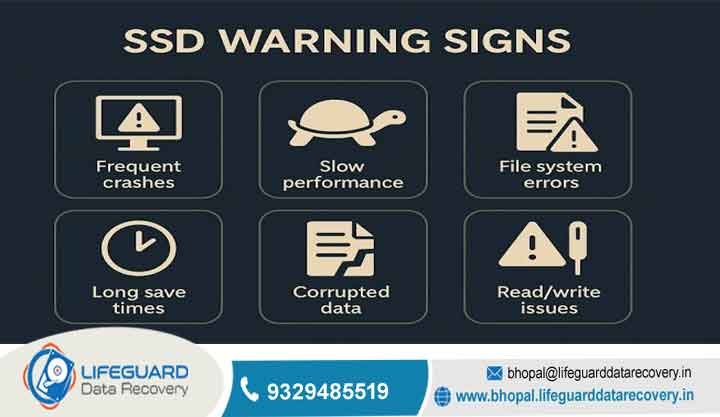
Key Symptoms of a Failing or Dead MacBook SSD
Detecting early warning signs of drive degradation or system failure allows you to extract critical files before total storage lockout occurs.
Flashing Question Mark Folder on Boot: When you power on your Mac, a folder icon containing a flashing question mark appears on the screen. This indicates that the Mac’s system firmware (Unified Extensible Firmware Interface / EFI) cannot locate a bootable macOS system folder or an intact APFS startup volume on the internal SSD.
Kernel Panics and Frequent System Freezes: The Mac suddenly restarts without warning, displaying a multi-lingual error message stating “Your computer restarted because of a problem.” This frequently happens when read/write operations attempt to access degrading NAND cells that can no longer return valid parity checks.
Read-Only Volume Lockdown: macOS suddenly mounts your startup drive in Read-Only mode, preventing you from saving new documents, taking screenshots, or deleting files.
When DIY Fails Professional MacBook SSD Recovery Services
There is a hard physical boundary where DIY software routines cease to work entirely. Understanding when to stop attempting home fixes is critical continuing to supply power to a failing or shorted motherboard can turn a simple repair into complete data destruction.
Why Software Cannot Fix Dead Modern Macs
On all modern MacBooks (2018+ Intel T2 models and all M1, M2, M3, and M4 Apple Silicon devices), the internal storage consists of raw NAND flash chips soldered directly onto the logic board surface.
Microscopic and Thermal Diagnostic Inspection: Engineers place the motherboard under high-powered optical microscopes to locate corrosion, physical cracks, or burnt components. They apply controlled electrical current to the board while viewing it through thermal imaging cameras to locate shorted capacitors that glow hot.
Precision Micro-Soldering Component Replacement: Using specialized hot-air rework stations and fine-tip soldering irons, technicians desolder burnt capacitors, corroded resistors, or failed PMICs, soldering healthy replacement components onto the board.
Power Rail Restoration: The objective is not to make the laptop cosmetically perfect or fully usable as a daily computer, but to repair the primary power rails specifically feeding the SoC, memory channels, and Secure Enclave.
Target File Extraction: Once the board can temporarily maintain power and initialize the Secure Enclave, engineers boot the system into Share Disk or Target Disk mode, copying the decrypted user data off the board onto an external storage device.
If you are dealing with a dead Apple Silicon Mac or severe liquid damage, contacting a professional MacBook SSD recovery service or an authorized professional MacBook data recovery laboratory is your safest and most reliable path to file retrieval.
Best Practices to Prevent MacBook SSD Data Loss
Adopt the 3-2-1 Backup Strategy: Keep 3 total copies of your important data, across 2 different storage media types (such as an external SSD and an off-site cloud server), with 1 copy stored entirely off-site.
Automate Background Time Machine Backups: Plug an external drive into your desktop setup or set up a Network-Attached Storage (NAS) device. macOS will run invisible background backups every hour, capturing local snapshots and keeping your system restore points completely up to date.
Safeguard Your FileVault Recovery Key: If you turn on FileVault disk encryption, ensure you write down the 28-character Recovery Key on paper and store it securely. If your Mac encounters system corruption and you lose both your account password and your Recovery Key, decrypting your files is mathematically impossible.
Monitor SSD Health using S.M.A.R.T. Attributes: Install disk diagnostic tools (such as DriveDx or command-line utilities like) to monitor the health percentage, temperature spikes, and percentage of remaining wear cycles on your internal NAND flash chips. Replace or back up your Mac immediately if health indicators drop below
Frequently Asked Questions
Can data be recovered from an M1, M2, M3, or M4 MacBook SSD?
Yes, but only if the physical motherboard can be powered on. If an Apple Silicon Mac is dead, traditional software tools cannot read the internal storage. Specialized lab engineers must perform component-level logic board repairs to power up the onboard Secure Enclave, decrypting the NAND data so it can be extracted.
Does disabling TRIM guarantee 100% data recovery success?
No. Disabling TRIM prevents macOS from dispatching immediate background zero-fill routines across unallocated space, significantly extending your window of opportunity. However, normal system operations or background cache creation can still write new files directly over those unallocated memory blocks.
How much does professional MacBook SSD data recovery cost?
Software-level recovery for healthy mounting drives typically ranges between Advanced hardware-level recovery involving liquid damage cleanup, micro-soldering, or dead Apple Silicon board repair generally costs between and depending on the complexity of the damage and lab equipment required.
Can I physically unsolder and remove the SSD from a dead modern MacBook Pro?
No. On all MacBooks manufactured after 2018 (including all Intel T2 and Apple Silicon M-Series models), the NAND flash memory cells are soldered directly onto the logic board and encrypted by the processor. Removing the chips destroys the circuit traces and renders the data cryptographically permanently inaccessible.