+971 50 217 6793 Abu Dhabi, UAE info@lifeguarddatarecovery.com


Can water-damaged storage devices be recovered?
Can Water-Damaged Storage Devices Be Recovered The Definitive Data Rescue Guide Finding out your storage device has taken an accidental plunge can trigger immediate panic. Whether it’s a laptop drenched in coffee, a hard drive caught in a basement flood, or an SD card that went through the wash, the immediate question is always the same
lifeguard datarecovery The short answer is yes, in the vast majority of cases, data can be successfully recovered after water damage. Because hard drives store data magnetically on solid platters and solid-state drives store it as electrical charges trapped inside insulated flash memory cells, water itself rarely erases your files.
However, your odds of a successful data rescue depend entirely on what you do in the minutes immediately following the accident.
The Immediate First Aid What to Do (and Avoid) in the First 60 Minutes
When a gadget gets wet, a hidden clock starts ticking down very fast. What you do with the device during this first hour decides if you can save your photos and files, or lose them forever. Most people panic and do the wrong thing, which accidentally kills their device for good. Let us look at how to handle this safely.
The 3 Golden Rules of Wet Device First Aid
Kill the Power Instantly: If your device is plugged into the wall, a computer, or running on battery, turn it off immediately. Don’t try to save your open files or click the proper “Shut Down” button. For laptops or external drives, just press and hold the power button down for a full 10 seconds. Force it to die. The longer electricity flows through wet circuits, the faster it burns out.
Remove All Peripherals: Pull out everything connected to it. Take out the charging cables, mouse wires, SD cards, and SIM card trays. If it is an external hard drive, take it out of its plastic outer case if you know how. Removing these parts helps stop water from getting trapped in small gaps.
Control the Moisture (The Counter-Intuitive Rule): Use a clean cloth to wipe the outside parts. Now, here is a secret that surprises many people: if your device fell into dirty water, like mud, sewage, or saltwater, do not let it dry out. When dirty water dries, it leaves behind crusty salt and minerals that lock onto the chips. Instead, wrap the wet drive in a clean, damp paper towel and put it inside a sealed plastic Ziploc bag. This keeps the dirt wet until a professional can clean it properly.
Debunking the Rice Myth: Why Silica Gel and Rice Make It Worse
We have all heard the old advice: “If your phone gets wet, put it in a bowl of raw rice.” Please, do not do this to your storage devices. It is a major myth that actually ruins electronics.
Rice absorbs water very, very slowly. While your device sits in a bowl of rice for two days, the water inside has plenty of time to rust the components. Even worse, raw rice is full of tiny white dust and starch particles. This fine dust slips inside the small holes, ports, and vents of your hard drive or SSD.
When the dust mixes with the water inside, it turns into a thick, sticky paste that glues itself onto the circuit board. Once this paste dries, it is incredibly hard to clean off, making professional water-damaged data recovery services much more difficult. If you want to dry something safely, skip the kitchen cabinet and use commercial silica gel packets—the little clear bead bags you find in new shoe boxes.
The Science of Liquid Damage: How Water Destroys Your Storage Media
To save your data, it helps to understand what water actually does to electronics. Surprisingly, pure water does not hurt circuits. The real enemies are the invisible minerals dissolved in the water and the electricity running through the device.
Freshwater vs. Saltwater vs. Sticky Liquids
Not all liquids damage your hardware at the same speed. The type of drink or water you spill changes your timeline completely:
Clean Tap Water or Rainwater: This is the easiest to deal with. It contains low mineral levels, so the rusting process happens slowly. You usually have a couple of days to get help.
Sugary or Acidic Drinks (Coffee, Soda, Juice, Tea): These are much worse. When they dry, they leave behind a sticky, gooey layer. This layer traps moisture against the metal parts and eats away at the electronics much faster than normal water.
Saltwater (Ocean water or Swimming Pools): This is an absolute emergency. Saltwater is a powerful conductor of electricity and attacks metal instantly. It can corrode and destroy the tiny circuits inside your drive in just a few hours.
Electrolysis and Corrosion: The Silent Killers
When water gets onto a circuit board while the battery is still giving it power, it triggers a fast chemical reaction called electrolysis.
The electricity uses the water to move tiny bits of metal from one path to another. It dissolves the copper pathways on the board and grows tiny, microscopic metal needles called dendrites. These needles spread out through the water until they touch another live circuit pathway. The moment they touch, it causes a short circuit, sending too much power to the wrong place and instantly frying expensive chips. Even after you turn the device off, if it stays wet, the oxygen in the air combines with the water to create rust (oxidation), which slowly eats through the metal wires until they snap apart.
Recovering Files from a Water-Damaged Hard Drive (HDD)
Old-school external hard drives and desktop drives are mechanical. Inside them, you will find shiny metal disks called platters that spin at incredibly high speeds, with a tiny mechanical arm that reads the data. Many people think these drives are completely airtight, but they are not. They have a tiny “breather hole” to let air pressure equalize inside, protected by a simple filter.
When a hard drive is submerged under water, liquid seeps through this hole and fills the inside chamber. As the water sits there or dries up, it leaves dirt, dust, and minerals directly on the mirror-smooth platters. If you try to turn on a wet or dirty hard drive, the mechanical arm.
which usually hovers just a microscopic hair above the platter will smash into these mineral bumps. This scratches the platters and scrapes away the actual magnetic layer where your files live. This is called a head crash, and it can delete your files forever. To perform a safe hard drive water damage recovery, engineers have to open the drive inside a dust-free cleanroom lab, wash the platters with special chemical cleaners, and replace the broken mechanical arm before reading the data.
Overcoming Water Damage on Solid-State Drives (SSD)
Solid-state drives (SSDs) are the newer drives found in modern laptops and external portable drives. They have zero moving parts. Instead, your files are saved as tiny electrical charges inside black square chips called NAND flash memory. These chips are usually sealed tightly in tough epoxy plastic, which naturally keeps water out.
Because of this design, the actual place where your data lives is very tough and rarely gets hurt by water. The problem is everything around the chips. The main circuit board has a brain called the controller chip and a power regulator chip (PMIC) that manages the electricity. When water hits an active SSD, these power chips usually short circuit and die instantly to protect the rest of the drive.
The drive looks completely dead, but your files are still safe inside the memory chips. Saving an SSD requires a technician with a microscope who can solder new parts onto the board to fix the power lines, or completely desolder the memory chips and place them onto a working donor board to read the files out.
Water-Damaged Laptop Data Recovery (MacBook & Windows)
Windows Laptops: Most Windows laptops use independent, modular SSDs that look like small sticks of chewing gum. If you spill water on your laptop and the computer dies, the storage drive itself is usually fine. A technician can simply unscrew the drive, clean it with pure isopropyl alcohol to remove any corrosion, and plug it into a cheap external adapter to read your files on another computer.
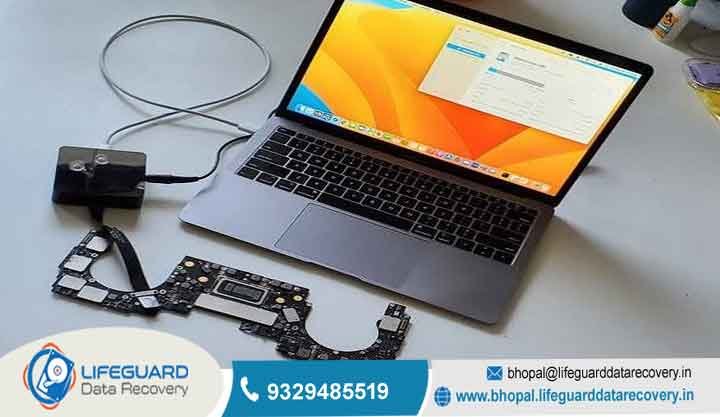
Modern MacBooks (Apple Silicon): Apple laptops are much harder to fix. On newer MacBooks, the storage chips are soldered permanently onto the main computer board. They cannot be unscrewed. To make it tougher, the files are heavily encrypted by the main Apple processor chip. You cannot just pull the chips off and read them elsewhere; the entire laptop board must be carefully cleaned and repaired under a microscope until it can turn on for just a few minutes so the security chip can decrypt and export your data.
Flash Media Salvage: USB Thumb Drives and SD Cards
Small memory cards used in cameras and phones are built as single, solid blocks of plastic with the chips molded inside. They have no empty space inside for water to hide. If you drop an SD card in water, it will almost always survive. Just wipe it clean with a little rubbing alcohol, let it sit out to dry for a day, and it should work fine. USB thumb drives are also quite tough, but make sure to check inside the metal plug plug-in area. If you see green or brown rust spots inside the plug, clean it out with a toothpick and alcohol before putting it into a computer.
When to Call the Experts: Professional Water Damage Data Recovery Services
If your drive was completely underwater, fell into salty ocean water, or holds irreplaceable photos or important work files, you should skip the home remedies and send it straight to a professional lab.
What Happens Inside a Dedicated Data Recovery Lab?
Professional recovery labs have specialized tools that you cannot buy at regular electronics stores:
Ultrasonic Cleaning Machinery: Technicians take the circuit boards out and place them into special tanks filled with chemical solvents. The machine uses high-frequency sound waves to create microscopic bubbles that blast away rust and corrosion from underneath the tiny chips without damaging the board.
ISO Certified Cleanrooms: These are special rooms where the air is filtered constantly to remove every single speck of dust. Technicians can safely open mechanical hard drives here without worrying about floating dust landing on the delicate platters.
Special Hardware Emulators: Labs use high-tech diagnostic tools like the PC-3000. These tools allow them to connect directly to the memory chips, bypass the broken parts of the drive, turn off bad sectors, and make a perfect copy of your files safely.
Frequently Asked Questions (FAQ)
Can data be recovered from a storage device that went through the washing machine?
Yes, quite often! Because SD cards and USB drives are tightly sealed in plastic or epoxy, they can handle being washed. The big danger is actually the heat from the clothes dryer or the soap residue left behind. Just make sure the device is completely clean and dry before you plug it into a computer. If it still has soap crust on it, rinse it gently in rubbing alcohol first.
How long does it take for a wet hard drive to begin corroding?
Rust and corrosion can start faster than you think—sometimes within just two hours. If the device fell into saltwater or a warm soda, the chemical reaction happens extremely fast. Clean tap water gives you a bit more time, but you should still try to get it treated within 24 to 48 hours.
Does putting a wet solid-state drive (SSD) in rice dry it out safely?
No, it does not. Rice does not stop rust from growing inside the drive and it fills the ports with annoying white starch dust. It is much safer to let the drive dry naturally in front of a small fan or use real silica gel packets.
Does property or business insurance cover the cost of professional data recovery?
Most basic insurance policies will pay to replace the physical laptop or hard drive if it gets destroyed in a home flood, but they rarely pay for the expensive laboratory work needed to extract your files. You usually need to buy a special extra coverage rider if you want insurance to pay for data recovery.