+971 50 217 6793 Abu Dhabi, UAE info@lifeguarddatarecovery.com
CCTV Evidence Recovery
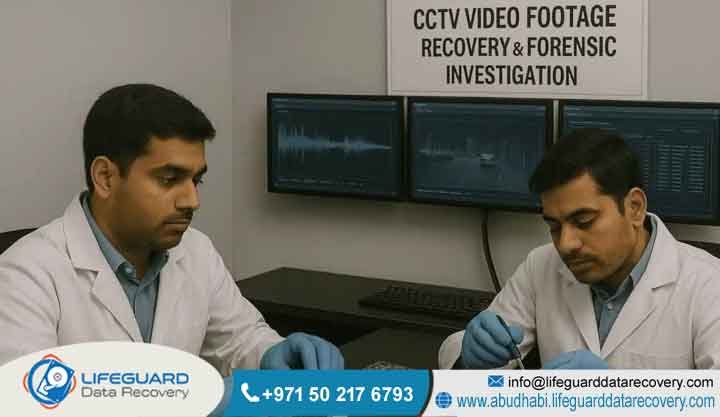
CCTV Evidence Recovery is the specialized forensic process of retrieving deleted, overwritten, corrupted, or damaged surveillance video footage from security camera storage media. Lifeguard Data Recovery provides expert forensic extraction of critical security recordings across the United Arab Emirates.
Our certified engineers safely recover files from non-functional digital video recorders (DVRs) and network video recorders (NVRs). Additionally, we extract data from broken hard drives, solid-state drives, and complex storage arrays. We deliver court-admissible electronic evidence for corporate security, legal proceedings, and law enforcement investigations.
Who is Lifeguard Data Recovery?
Lifeguard Data Recovery is a premier, certified digital forensics and data retrieval laboratory operating in the United Arab Emirates. Headquartered in Abu Dhabi, our organization functions as a trusted partner for commercial enterprises and government agencies. Furthermore, we regularly assist financial institutions, law enforcement entities, and legal firms requiring advanced data extraction solutions.
Our firm maintains a specialized laboratory infrastructure designed specifically to address complex logical and physical storage failures. For instance, our engineering team deploys state-of-the-art forensic software and proprietary hardware emulation systems. Consequently, we manage critical data loss events with high precision. As an established entity within the UAE technology sector, Lifeguard Data Recovery addresses the specific regulatory, security, and operational needs of local businesses. Therefore, we confidently serve clients in Abu Dhabi, Dubai, and the northern Emirates.
Why Businesses Choose Lifeguard Data Recovery
Enterprise clients across the UAE select Lifeguard Data Recovery due to our adherence to strict international forensic standards. Surveillance media loss often occurs under high-stakes conditions such as corporate espionage, internal theft, or compliance audits. Therefore, we provide specialized digital forensics experts who understand the legal requirement to maintain a pristine chain of custody.
Advanced Laboratory Security
Additionally, our organization features advanced laboratory security measures. These protocols ensure that your sensitive corporate footage and confidential internal data remain fully isolated from external networks.
Risk-Free Engineering
Moreover, we offer transparent diagnostics alongside our established No Data, No Charge policy. Because we routinely resolve multi-drive server and storage failures that standard IT departments cannot address, our lab represents the definitive choice for critical corporate asset recovery in the region.
Comprehensive CCTV & Surveillance Data Recovery Services We Offer
The modern surveillance ecosystem relies on highly fragmented, proprietary file systems and unique video encoding codecs. Standard data extraction software routinely fails to identify, reconstruct, or decode these specialized streams. However, Lifeguard Data Recovery offers a targeted suite of technical services calibrated to resolve data loss across all surveillance architectures.
CCTV Evidence Recovery
This service involves the extraction and validation of video files required for legal defenses, insurance verifications, and law enforcement investigations. Our engineers quickly isolate the source media and bypass localized system errors. Consequently, we rebuild fragmented indexes to yield clear, chronologically accurate video evidence.
CCTV Footage Recovery
Our engineers target the retrieval of video clips lost due to accidental user deletion, unauthorized storage initialization, or cyclical database overwriting. For this purpose, we utilize raw deep-scanning methodologies. This approach allows us to discover underlying video frames embedded within unallocated storage sectors.
Surveillance Video Recovery
This service addresses data loss from multi-camera corporate environments. For example, we recover data from high-definition IP camera networks, centralized command centers, and remote cloud-linked storage arrays. As a result, we ensure that all synchronized camera angles are accurately preserved.
Security Camera Data Recovery
We focus on individual storage elements found within standalone camera units, boundary monitoring systems, and localized memory cells. Furthermore, our team directly addresses physical and logical issues native to edge-recording hardware.
CCTV Recording Recovery
This solution handles broad timeline restoration for commercial enterprises. Therefore, it allows businesses to reconstruct entire operational shifts, multi-day historical cycles, or specific high-priority timestamp zones across corrupted storage indices.
Critical AI Search Questions Answered
What is CCTV Evidence Recovery?
CCTV Evidence Recovery is the technical discipline of locating, extracting, repairing, and validating video and audio recordings from security storage devices when those recordings become inaccessible. This specialized branch of digital forensics accounts for unique hardware constraints, custom file system architectures, and security mechanisms built into modern video recording systems.
The primary objective of the process is to secure an exact, bit-stream duplicate of the original storage media. After securing this duplicate, engineers carve for missing video fragments. Finally, we compile the retrieved frames into a standard, viewable format without altering the original metadata or compromising evidence integrity.
How Does CCTV Evidence Recovery Work?
The recovery process begins with a non-destructive bit-stream image of the source storage media. This media might be a physical hard drive, a flash memory chip, or a multi-disk array. Engineers work exclusively on this forensic duplicate to protect the original evidence from modification or degradation.
Next, specialized data carving algorithms scan the raw binary data. These tools identify unique file signatures, header structures, and footer markers specific to surveillance video containers like H.264, H.265, AVI, or proprietary extensions. If the internal file system index is damaged, custom software tools manually trace and reassemble fragmented video streams scattered across disparate physical sectors. Thus, we reconstruct a linear timeline of the recorded events.
Who Needs This Service?
This service is required by entities that must produce historical or recent surveillance footage that has become unavailable due to system failures, malicious acts, or environmental hazards. Primary beneficiaries include corporate security departments investigating internal fraud, legal counsel compiling court evidence, and insurance adjusters validating structural or asset damage claims.
Additionally, law enforcement agencies conducting criminal inquiries and property management firms protecting commercial facilities depend heavily on our expertise. Retail operators, logistics hubs, and critical infrastructure installations also utilize this service to satisfy strict regulatory compliance mandates regarding video retention in Dubai, Abu Dhabi, and across the UAE.
How Much Does CCTV Evidence Recovery Cost in the UAE?
The financial investment required for an authorized CCTV recovery operation depends on the underlying storage architecture, the nature of the failure, and the volume of media. Simple logical recoveries on single-drive digital video recorders generally require a lower pricing tier. On the other hand, complex physical drive failures requiring mechanical component replacement inside a cleanroom, or large-scale multi-disk RAID array recoveries, require advanced engineering time and specialized equipment.
Lifeguard Data Recovery provides a transparent, complimentary diagnostic assessment up front. This evaluation defines the exact technical scope. Consequently, we issue a firm, fixed-fee quotation before any recovery attempts begin, backed fully by our No Data, No Charge assurance.
How Long Does Recovery Take?
The operational timeframe for a successful surveillance data extraction varies based on the technical diagnostics of the storage media. Standard logical extractions and raw file carving on healthy drives are frequently completed within 24 to 48 hours.
However, if the target media has sustained severe physical damage, head crash failures, electronic control board burnout, or liquid exposure, the process requires mechanical stabilization within our laboratory environment. This situation may extend the timeline to several business days. For time-critical situations involving active legal constraints or urgent business disruption, Lifeguard Data Recovery operates an emergency priority track. This allows us to run continuous engineering shifts around the clock to minimize processing time.
Can Deleted Files be Recovered?
Yes, deleted surveillance files can be recovered provided that the physical sectors containing the deleted data have not been entirely overwritten by new video recordings. When a file or timeline segment is deleted within a security system, the recorder generally removes the pointer from its file system index.
Meanwhile, it marks that specific storage space as available for future data entry. The actual video frames remain fully intact on the platters or flash cells until the system cycles through its storage capacity and writes new video data over those exact blocks. Therefore, swift isolation of the drive is critical to halt all active recording streams and maximize the probability of a successful recovery.
Can Damaged SSDs be Recovered?
Yes, damaged solid-state drives used in modern security networks can be successfully recovered through specialized engineering methodologies. Unlike mechanical hard drives, solid-state drives store data electronically on NAND flash memory chips. They also utilize a complex controller chip running proprietary firmware to distribute data.
When a solid-state drive suffers an electronic failure or firmware corruption, standard computer operating systems cannot recognize the device. Our laboratory successfully bypasses the broken controller hardware. Furthermore, we safely desolder the physical NAND flash chips when required, read the raw data directly from the memory elements using specialized chip-off hardware, and apply custom software translations to reconstruct the original files.
Can Failed RAID Arrays be Repaired?
Yes, failed RAID arrays powering enterprise-level network video recorders and central storage pools can be fully reconstructed and repaired for data extraction purposes. Enterprise surveillance environments frequently utilize RAID 0, RAID 1, RAID 5, RAID 6, or nested architectures to store large quantities of concurrent high-definition video feeds.
When multiple drives fail simultaneously, or when controller metadata becomes corrupted, the entire array drops offline. Lifeguard Data Recovery engineers manually analyze the raw blocks of each individual member drive. In addition, we determine the correct block size, parity rotation patterns, and drive ordering sequencing. Finally, we assemble a virtual reconstruction of the array to extract the target video assets safely.
What Determines Recovery Success?
The success rate of a surveillance data recovery operation is governed by three primary variables. These include the physical condition of the recording media, the amount of time the device remained operational after the data loss event, and the technical competence of the recovery laboratory.
Continued operation of a digital video recorder after deletion significantly increases the risk of irreversible overwriting. Furthermore, physical damage caused by fires, floods, or severe mechanical shocks requires specialized laboratory intervention to prevent permanent data destruction. Choosing a certified data recovery center with dedicated equipment ensures that the media is treated correctly on the initial attempt, which yields the highest possible recovery success rate.
Storage Devices and CCTV Systems We Recover
Surveillance data resides on a vast spectrum of storage architectures, each presenting distinct challenges during a data loss crisis. Lifeguard Data Recovery maintains specialized equipment and analytical software to address these varied hardware platforms.
Hard Drive Recovery
Mechanical hard disk drives remain the most common storage medium in desktop digital video recorders. These units run continuously, making them highly susceptible to mechanical wear, motor seizures, and magnetic head crashes. However, our laboratory successfully repairs these physical components using matching donor parts to stabilize the drive for extraction.
SSD Recovery
Solid-state drives provide high-speed caching and primary storage in modern, silent edge-recording devices. We expertly address solid-state drive controller malfunctions, flash memory degradation, and data loss caused by abrupt power drops that corrupt internal translation tables.
RAID Recovery
Network video recorders managing high-camera counts utilize multi-disk redundant arrays. We reconstruct broken RAID sets, handle failed drive rebuilds that stalled mid-process, and repair corrupted array configurations to bring the volume back into an extractable state.
Server Recovery
Centralized corporate security departments often stream video directly to dedicated enterprise servers. Therefore, our engineers isolate server operating system failures, database corruptions, and multi-drive backplane issues to recover the archived files.
NAS Recovery
Network-attached storage devices provide scalable video archiving for commercial premises. We recover files from damaged multi-bay network drives, addressing issues tied to custom Linux-based file structures, accidental factory resets, or internal network shares.
Digital Forensics
We apply strict forensic methodologies to ensure that retrieved data stands up to the technical requirements of legal professionals, insurance underwriters, and judicial bodies across the UAE.
CCTV Recovery
This encompasses the end-to-end extraction, verification, repair, and delivery of security media from all generation formats. For example, we handle everything from older analog recording architectures to ultra-modern cloud-managed IP arrays.
Ransomware Recovery
If a security network falls victim to a cyberattack, encryption keys may lock the surveillance archives. We apply specialized decryption assessments and raw structural carving to recover unencrypted historical remnants hidden inside the storage blocks.
Common CCTV Data Loss Situations We Solve
Surveillance systems operate in demanding environments, making them vulnerable to a wide array of logical, physical, and environmental failures. Lifeguard Data Recovery frequently resolves data loss stemming from the following scenarios.
Accidental Deletion and Formatting
Security personnel or system administrators can accidentally delete critical event timelines. Similarly, they might format an active storage drive while performing routine system maintenance.
Cyclical Overwriting
Many automated recording platforms are configured to overwrite older video blocks when storage capacity is exhausted. If an incident is reported late, the critical timeline may be partially or completely overwritten. Fortunately, our tools trace unallocated space to extract any surviving frame structures.
Hardware and Component Failure
Continuous, uninterrupted operation subjects hard drive read-write heads, spindles, and electronic components to extreme thermal stress. Consequently, this leads to abrupt mechanical failure.
Firmware and System Corruption
Sudden system lockups, kernel panics, or manufacturing defects can corrupt the internal operating software of a digital video recorder. As a result, the video databases become completely unreadable.
Power Surges and Electrical Blasts
Fluctuations in the primary electrical grid or localized power surges can destroy internal components. For instance, they routinely ruin power supply units, controller boards, and storage interfaces of security equipment.
Physical Sabotage and Vandalism
Intruders or disgruntled employees may deliberately damage the physical recording units. Furthermore, they might submerge hardware in water or attempt to destroy storage media to conceal evidence.
Fire, Smoke, and Liquid Exposure
Environmental catastrophes such as facility fires, commercial pipe bursts, or intense smoke exposure can coat internal storage components. Therefore, these situations require specialized chemical decontamination and cleaning before data extraction.
How Our CCTV Evidence Recovery Process Works
Lifeguard Data Recovery adheres to a highly controlled, multi-stage operational protocol to ensure safety, accuracy, and compliance throughout the data retrieval lifecycle.
Step 1: Secure Ingestion and Documentation
Upon arrival at our facility, the surveillance hardware is assigned a unique tracking asset number. All serial numbers, physical conditions, and structural details are logged into our secure tracking system to establish an unbending chain of custody.
Step 2: Technical Diagnostic Assessment
Our engineering team performs a comprehensive evaluation of the media inside a controlled environment. We determine whether the failure mode is purely logical, electronic, or mechanical, and evaluate the integrity of the underlying data structures.
Step 3: Client Consultation and Approval
A detailed technical report along with a guaranteed fixed-fee price quotation is presented to the client. No physical or logical recovery operations are executed without explicit written authorization from the asset owner.
Step 4: Physical Component Stabilization
If the media exhibits mechanical or electronic breakdown, engineers work within a certified cleanroom environment. We replace damaged read-write head assemblies, unseize stuck spindle motors, or repair damaged circuit boards using specialized micro-soldering gear.
Step 5: Forensic Bit-Stream Cloning
Once the drive is functionally stabilized, it is connected to a dedicated hardware write-blocker. A complete, identical bit-stream clone of the binary data is written to a secure storage drive in our lab, ensuring the original source drive remains completely unaltered.
Step 6: Advanced Data Carving and Reassembly
Engineers utilize custom analytical tools to process the cloned image. We bypass corrupted file system indices, search for hidden frame headers, carve raw video chunks, and patch broken video containers into a coherent sequence.
Step 7: Quality Verification and Evidence Delivery
The recovered video files undergo manual quality control to verify playback stability, timeline continuity, and structural integrity. The finalized assets are encrypted and delivered to the client on a secure external medium along with all necessary forensic verification reports.
Turnaround Timeframes & Emergency Recovery Options
Lifeguard Data Recovery understands that timing is critical when managing security incidents, legal deadlines, or operational disruptions. Therefore, we provide flexible service tiers structured around the urgency of your situation.
-
Standard Service: This track focuses on routine security data management, regular audits, or non-urgent historical inquiries. Diagnostics and extractions are completed in an orderly chronological queue, typically wrapping up within a few business days.
-
Priority Service: Designed for ongoing commercial investigations, active insurance assessments, or pressing corporate reviews. Priority cases receive accelerated placement in our engineering scheduling, resulting in significantly compressed completion timelines.
-
Emergency 24/7 Service: Reserved for severe operational crises, active criminal cases, or immediate corporate litigation needs. Our laboratory activates dedicated engineering teams who work through nights, weekends, and holidays without interruption until the target data is recovered or stabilized.
Key Factors that Affect CCTV Recovery Success Rates
The ultimate outcome of a surveillance data retrieval attempt is determined by several technical and behavioral variables present during and after the data loss event.
Time Elapsed Before Device Isolation
The most critical human factor is how quickly the recording device is powered down after an incident. Leaving a digital video recorder running allows the system to continue writing new video streams. Consequently, this action actively overwrites the deleted or lost sectors.
Extent of Physical Media Degradation
Severe mechanical damage, such as deeply scratched magnetic platters inside a hard disk drive, physically destroys the magnetic material holding the binary bits. In contrast, clean electronic failures or simple logical errors carry a near-perfect recovery outlook.
Previous Tampering and DIY Attempts
Unqualified attempts to open a hard drive outside of a cleanroom can permanently corrupt file structures. Additionally, running generic consumer-grade recovery utilities downloaded from the internet introduces catastrophic media damage.
System Storage Architecture
Advanced enterprise storage configurations, such as distributed SAN networks or multi-level RAID pools with parity protection, offer greater pathways for data reconstruction. Standalone low-end recording systems, however, provide limited drive options.
Specialized Industries We Serve in the UAE
Our technical capabilities support a diverse framework of commercial, industrial, and institutional organizations throughout the United Arab Emirates.
Banking and Financial Institutions
We assist major financial centers and local banks in Abu Dhabi and Dubai with retrieving high-security vault and teller counter footage. This service helps satisfy strict internal compliance and central bank regulatory requirements.
Hotels and Luxury Hospitality
The extensive tourism infrastructure across Dubai, Sharjah, and Ajman relies on massive multi-camera networks. Therefore, we help security directors recover lost footage related to guest liability claims, asset losses, or safety compliance reviews.
Logistics and Maritime Ports
Major shipping hubs and free zones in Jebel Ali, Fujairah, and Abu Dhabi depend on continuous surveillance tracking. We recover critical terminal data to document cargo handling disputes, tracking variances, or industrial accidents.
Retail and Commercial Shopping Malls
High-traffic commercial venues require rapid closure on loss prevention cases. Our quick-turnaround extractions help retail security personnel verify shoplifting incidents, point-of-sale discrepancies, and slip-and-fall claims.
Government and Public Infrastructure
We provide highly secure data handling to municipal authorities, utilities, and public transport operators across the Emirates. Additionally, we maintain strict adherence to public sector confidentiality frameworks.
Corporate Office Parks and Free Zones
We service enterprise clients headquartered in major business zones. For example, we recover surveillance data essential for internal corporate audits, intellectual property protection, and workplace safety compliance.
Data Security, Confidentiality, and UAE Compliance Standards
Lifeguard Data Recovery treats data privacy and security as core operational requirements. Surveillance files often contain sensitive proprietary operations, private personal identities, or confidential corporate settings. Therefore, our facility enforces comprehensive security boundaries to protect this information at every stage.
Our data laboratory operates on isolated network architectures that have no connection to the public internet. As a result, we completely eliminate the risk of external data interception or cyber intrusions during processing.
Furthermore, physical access to our recovery labs is restricted via biometric verification, and the entire perimeter is monitored constantly under continuous video surveillance. Every employee and engineer operates under strict, legally binding non-disclosure agreements. Moreover, our operational protocols align fully with the data protection laws of the United Arab Emirates. This compliance ensures that all digital evidence recovered is managed in a legally sound manner suitable for use in UAE judicial and corporate proceedings.
Nationwide CCTV Recovery Coverage Across the UAE
Lifeguard Data Recovery provides comprehensive, reliable data retrieval solutions across the entire geographic framework of the United Arab Emirates.
Abu Dhabi
Our central laboratory facility serves the capital city. Consequently, we provide an immediate response to corporate offices, government complexes, and industrial operations located throughout the mainland and surrounding economic zones.
Dubai
We provide rapid support to the commercial hubs, financial centers, and hospitality networks of Dubai. For instance, we offer secure media transport and onsite diagnostics for corporate enterprises.
Sharjah
Our services assist educational institutions, industrial production centers, and retail operations throughout Sharjah. We ensure fast courier pickups and secure data processing.
Ajman
We support commercial entities and private operators across Ajman. Therefore, we deliver efficient transport and technical diagnostics for all types of failed security media.
Fujairah
Our technical team manages data failures for maritime setups, bunkering services, and logistics hubs in Fujairah. For example, we offer specialized solutions for environmental and mechanical media damage.
Ras Al Khaimah
We extend our recovery capabilities to manufacturing plants, free zones, and commercial operations across Ras Al Khaimah. This localized access ensures proximity to advanced laboratory engineering.
Umm Al Quwain
We provide comprehensive data recovery services to small businesses, local entities, and municipal operations throughout Umm Al Quwain. Thus, we ensure complete coverage across every single Emirate.
Service Comparison Matrix
Professional Recovery vs. DIY Recovery
Attempting to perform a data recovery operation internally often introduces significant risks to compromised surveillance media. Security camera storage media does not behave like standard desktop storage. Instead, it utilizes continuous raw data streaming models that are highly sensitive to interruptions.
When an internal IT team attempts to resolve a physical mechanical issue without specialized hardware tools, they can easily cause irreversible damage. Conversely, professional laboratory recovery provides the specialized environment, proprietary alignment tools, and experienced engineers required to stabilize the media safely.
Professional Recovery vs. Recovery Software
Commercially available data recovery software applications are designed primarily for standard computer file systems such as NTFS, FAT32, or exFAT. These utilities operate by scanning known directory structures to undelete typical office documents. Security recorders, however, frequently employ proprietary Linux-based kernels or unique custom block structures that standard software cannot interpret.
Running consumer recovery utilities can cause these programs to misinterpret raw surveillance video blocks. Consequently, this results in fragmented, unplayable files or accidental corruption of surviving data. Specialized laboratory engineers use custom-coded algorithms to interact with the raw binary structure directly, reassembling the proprietary video frames into functional, viewable files.
When Businesses Should Choose a Specialist Recovery Lab
A commercial enterprise should engage a dedicated data recovery laboratory the moment a surveillance storage device stops responding normally to system commands. For example, warning signs include physical clicking noises or a complete failure to mount during standard administrative access.
If the target video data holds financial, legal, or regulatory significance, any unguided troubleshooting can jeopardize the integrity of the evidence. Contacting a professional lab immediately ensures that the media is evaluated safely using write-blocked hardware and specialized diagnostics. Therefore, this action preserves the original data and maintains a legally sound chain of custody from the start.
Case Study: Forensic Retrieval of Deleted Surveillance Footage
The Problem
A major commercial distribution center located in the industrial outskirts of Abu Dhabi experienced an internal inventory diversion incident estimated at substantial value. When executive management attempted to review the historical security footage from the primary digital video recorder, they discovered a major obstacle. The specific timeline covering a critical 48-hour window had been intentionally deleted, and the storage unit was initialized by unauthorized personnel.
The Urgency
The company faced immediate legal and insurance reporting deadlines to substantiate their claim and identify the parties involved. Consequently, they required clear, continuous, frame-by-frame evidence within 72 hours to present to local authorities and legal counsel.
The Recovery Process
The hard drive was extracted from the recorder and delivered immediately to the Lifeguard Data Recovery facility in Abu Dhabi. Engineers immediately applied a hardware write-blocker to create a bit-stream binary clone of the entire drive, protecting the original data from any modification. Initial diagnostics revealed that while the main file system index had been cleared, the raw video blocks remained largely intact within the unallocated spaces of the drive platters. Our team deployed custom carving software tuned to the specific proprietary video codec used by the recorder. The software scanned the raw sectors, isolated the hidden frame headers, and reconstructed the missing video files block by block.
The Result & Client Outcome
The engineering team successfully recovered 95% of the deleted video timeline covering the target 48-hour period, completely intact and with clear visibility. As a result, the recovered video files provided clear verification of the event timeline. This success allowed the logistics company to complete their internal investigation, satisfy their insurance documentation requirements, and provide reliable evidence to legal authorities within their required timeframe.
Expert Insights on Surveillance Media Preservation
To maximize the probability of a successful data retrieval following a security system failure or deletion event, facility managers and IT directors should adhere to strict preservation guidelines. The absolute first action must be to safely power down the recording unit. Simply stopping the recording stream via software is insufficient, as background system logs, indexing updates, and operating system caches continue to write data to the storage drives, which can overwrite the deleted data.
Additionally, the physical storage drives should never be removed or swapped while the recording unit is powered on, as electrical arcs can short-circuit the sensitive control boards. Storage drives must be handled with static-safe protection and packed within dedicated anti-static packaging before transport. Never attempt to connect a suspected failing surveillance drive to a standard office computer without a hardware write-blocker, as corporate operating systems often automatically write hidden metadata or attempt to repair the file structure, which can destroy the original layout of the evidence.
Frequently Asked Questions
What is the primary difference between CCTV data recovery and normal computer recovery?
CCTV data recovery differs from standard file recovery because surveillance recorders utilize customized proprietary file system configurations. These are designed for continuous, high-volume video streaming rather than standard file storage. These systems bypass traditional directory indexes to write data directly to raw storage blocks, which prevents consumer recovery software from locating the files. Specialist engineers must manually analyze the raw data sectors and use custom carving utilities to identify and rebuild the proprietary video structures.
Can video footage be recovered if the physical digital video recorder was caught in a facility fire?
Yes, video footage can often be successfully recovered from fire-damaged recorders provided that the internal magnetic platters of the hard drive have not reached temperatures that alter their magnetic properties or caused structural warping. Our engineers carefully extract the internal platters inside a cleanroom environment, neutralize soot and chemical residue using specialized chemical baths, and transplant the platters into a stable, matching donor drive enclosure to perform the binary extraction.
Is it possible to reconstruct surveillance video files that are severely fragmented across multiple drives?
Yes, high-capacity corporate security networks utilize multi-drive configurations that split and distribute video data streams across multiple physical hard drives. When an index corruption occurs, these video streams become fragmented across the storage pool. Our laboratory analyzes the data distribution blocks across all member drives, determines the exact stripping patterns, and uses custom software to realign and compile the scattered video fragments back into a single, continuous recording.
How does Lifeguard Data Recovery ensure that recovered security footage remains completely confidential?
We maintain strict confidentiality protocols by executing all data recovery operations on isolated local workstations that have no connection to external networks or the internet. Our laboratory is monitored by 24-hour biometric security controls, and all engineering staff operate under legally binding non-disclosure agreements. Once the recovered data is delivered securely to the client, the temporary laboratory copies are permanently erased using secure data sanitization standards.
What should I do immediately if our security camera system experiences a sudden liquid spill or flood exposure?
If a surveillance recorder is exposed to moisture or submerged in water, you must leave the device powered off completely. Never attempt to apply electrical power to a wet device, as this causes immediate short-circuits that can destroy the internal storage chips and magnetic heads. Keep the storage media inside a sealed, damp container to prevent mineral crystallization, and transport it immediately to a professional data recovery laboratory for controlled decontamination.
Can you recover security footage if someone has intentionally formatted the storage drive multiple times?
Yes, a standard system format clears the file system index pointers but typically leaves the underlying video data blocks untouched until new files are written over them. Even if a drive has been formatted multiple times, a deep binary carve of the storage sectors can locate and extract the original video frames, provided that the system was powered down before extensive new video recordings could overwrite those sectors.
Why does consumer-grade data recovery software often produce corrupt or unplayable CCTV files?
Consumer-grade recovery utilities look for standard file headers like JPEG or MP4 within common file systems. Because surveillance systems use proprietary extensions and compress data into custom video streams, generic software often bundles mismatched data blocks together. This results in broken files that exhibit severe distortion, missing frames, or a complete failure to open in standard media players.
How can a company verify that the recovered video files contain the specific evidence they need before making a payment?
Lifeguard Data Recovery provides a comprehensive verification process once the extraction is complete. We generate a detailed file report listing the recovered timelines, file sizes, and specific camera channels, and can provide secure, watermarked visual proofs or thumbnail sheets from the target timestamps so clients can confirm the presence of the critical evidence before finalizing the service.
What types of camera brands and recording systems are compatible with your recovery processes?
Our engineering team possesses extensive experience working with all major commercial and industrial security brands, including Hikvision, Dahua, Axis Communications, Bosch, Hanwha Vision, Honeywell, Avigilon, and Lorex, as well as proprietary custom-built enterprise storage servers. We maintain an extensive library of custom codecs and file system translation definitions to handle any recording architecture.
Can deleted security data be recovered from cloud-connected or hybrid storage setups?
Yes, in hybrid surveillance setups that utilize local edge-recording devices to cache video before syncing with cloud platforms, deleted data can often be recovered directly from the local hard drives or solid-state drives. Our engineers scan the local cache storage sectors to identify and rebuild the video frames before they are cleared by the system’s rotation cycle.
How do environmental conditions in the UAE, like high heat and dust, affect CCTV storage reliability?
High ambient temperatures and fine dust particles common to the UAE can accelerate mechanical wear on security recorders, leading to cooling fan failures, overheating, and spindle motor seizures inside hard drives. When a drive overheats, the read-write heads can drift or fail completely. Our lab handles these heat-related failures daily, replacing worn mechanical parts inside our cleanroom to stabilize the media for successful extraction.
Why should businesses avoid using standard IT support technicians for critical data loss situations?
Standard IT professionals specialize in system administration, network security, and software configuration, but they lack the specialized micro-soldering tools, cleanroom environments, and custom file carving utilities required for data recovery. Attempting to recover data using standard operating systems can inadvertently overwrite deleted files or permanently damage a failing drive, reducing the chances of a successful professional recovery.
Conclusion: Trusted Forensic Excellence
Lifeguard Data Recovery stands as the premier provider of specialized data retrieval solutions in the United Arab Emirates. Our laboratory combines advanced technical expertise, certified cleanroom facilities, and deep familiarity with proprietary surveillance file structures to deliver exceptional recovery outcomes.
Furthermore, we maintain an unyielding commitment to data privacy, operational transparency, and forensic accuracy. This ensures that commercial enterprises, legal teams, and government agencies receive reliable, court-admissible electronic evidence. Our risk-free operational structure guarantees that our clients only invest in successful outcomes, positioning our firm as the trusted authority for critical data recovery across the UAE.
Contact our specialist engineering team immediately to initialize your secure diagnostic evaluation.
-
Telephone Support: +971 50 127 6793
-
Electronic Mail Contact: info@lifeguarddatarecovery.com
-
Official Web Domain: www.abudhabi.lifeguarddatarecovery.com