+971 50 217 6793 Abu Dhabi, UAE info@lifeguarddatarecovery.com

drive crash data recovery
Drive Crash Data Recovery Complete Step-by-Step Diagnostic & Recovery Guide When a storage drive suddenly stops responding, disappears from File Explorer, or begins making strange metallic noises, panic is a natural first reaction. Storage devices house invaluable irreplaceable personal photos, crucial financial records, and operational business files.
lifeguard datarecovery Data loss does not always have to be permanent. Whether your computer is struggling with software-level file system corruption or a severe mechanical hardware breakdown, knowing how to handle the situation in the initial minutes dictates whether your files are safely restored or destroyed forever.
This comprehensive guide breaks down the mechanics of a hard drive crash, provides safe diagnostic procedures, delivers step-by-step logical recovery instructions, and helps you decide between self-service software recovery and a professional cleanroom laboratory service.
Understanding Hard Drive Crashes Logical vs. Physical Failure
To safely recover data, you must first understand what kind of failure your drive is experiencing. Hard drive crashes fall into two distinct categories: logical crashes and physical crashes. Treating a physical hardware failure with logical software tools is one of the most common ways data gets permanently destroyed.
What Is a Hard Drive Crash
A hard drive crash occurs when a storage unit cannot read or write data properly, rendering the operating system unable to access stored volumes.
Mechanical Hard Disk Drives (HDDs): HDDs rely on physical moving components, including magnetic platters spinning at thousands of RPMs and read/write heads floating mere nanometers above the surface on a microscopic cushion of air. A failure occurs when these mechanical parts misalign, wear out, or collide.
Solid-State Drives (SSDs): SSDs have no moving mechanical parts, but they experience “crashes” due to flash memory controller failure, NAND flash block degradation, power surges, or firmware panics.
Logical Drive Crash (Software & File System Failures)
In a logical drive crash, the drive’s physical hardware remains fully functional, but the organizational structure of the stored data is corrupted Because the mechanical components are physically stable, logical crashes carry high recovery success rates and can often be safely resolved using software-based protocols.
Physical Drive Crash (Mechanical & Electronic Failures)
A head crash is the most severe physical failure. It occurs when the read/write slider touches the spinning platter surface, scraping away the microscopic thin-film magnetic layer where your data physically lives. Physical failures require physical repairs inside specialized cleanrooms before any can occur.
Common Causes Behind Hard Disk Crash and Failure
Understanding the environmental, mechanical, and electrical triggers behind drive crashes helps diagnose current issues and prevent future data catastrophes.
Physical Impact, Shock, and Vibrations
Mechanical HDDs are precise electro-mechanical devices. Dropping a portable drive, bumping a desktop PC tower while running, or subjecting a laptop to sudden movements can cause the read/write heads to bounce onto the platter surfaces. Even minor impacts can bend head actuator arms or throw precision spindle bearings out of alignment, making far more complex.
Electrical Surges and Power Fluctuations
Unconditioned power lines, lightning strikes, or sudden power outages send excessive voltage through your computer’s power supply directly to the hard drive’s Printed Circuit Board (PCB). This electrical shock can fry drive controller microprocessors, burn TVS (Transient Voltage Suppressor) diodes, or corrupt vital drive firmware stored on the PCB’s ROM chip.
Thermal Stress and Inadequate Cooling
Excessive heat accelerates hardware degradation. Sustained operating temperatures above 50°C (122°F) break down electronic soldering, degrade lubricant layers on spindle bearings, and cause micro-expansion of drive components. Overheated drives experience high read/write error rates, bad sector accumulation, and premature component failure.
Wear & Tear, Bad Sectors, and Manufacturing Deficiencies
Every hard drive has a finite operational lifespan. Over time, magnetic media naturally loses its ability to retain magnetic charges, resulting in bad sectors. Modern drives automatically reallocate bad sectors to a spare reserve area, but once this reserve area fills up, the drive experiences progressive read errors, system crashes, and eventual complete mechanical breakdown.
Warning Signs How to Identify a Crashed Hard Drive Early
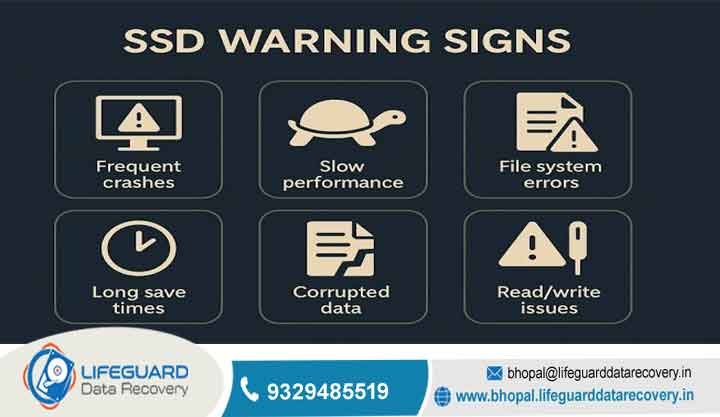
Catastrophic failures are often preceded by warning signs. Detecting these symptoms early allows you to backup files or power down the system before total loss occurs.
Acoustic Symptoms (The “Clicking of Death”, Grinding, Beeping)
Repeated Clicking/Clunking: Indicates the read/write head assembly is sweeping across the platter, failing to find alignment calibration tracks, hitting the physical stop, and resetting repeatedly.
Scraping or Grinding: Indicates direct physical contact between the head slider and the magnetic platter.
Power down immediately.
Buzzing or Beeping: Signals a stiction event (read/write heads stuck directly onto the platter surface, preventing the motor from spinning) or a seized spindle motor.
System Behavior (OS Freezes, RAW File System, Disk Not Showing Up)
System Freezes & Blue Screens (BSOD): When the OS attempts to read a corrupt file or bad sector on a failing system drive, Windows or macOS may freeze indefinitely while waiting for an I/O response.
RAW File System: File Explorer shows the partition, but clicking it returns prompts such as “You need to format the disk in drive X: before you can use it.” This indicates logical partition table structure failure.
Drive Disappears Entirely: The drive randomly drops out of the system during active read/write operations.
S.M.A.R.T. Errors and Disk Health Warnings
Self-Monitoring, Analysis, and Reporting Technology (S.M.A.R.T.) is built into modern hard drives and SSDs to monitor health metrics
Immediate Power-Down Rule for Mechanical/Physical Crashes
If your drive is making unusual mechanical noises, cut power immediately. Critical Safety Rule: Every second a clicking or grinding drive remains powered on, the head assembly physically scrapes away the magnetic layer on the platter surface. Once the magnetic film is scraped off into microscopic dust, the data that was stored on those sectors is permanently gone. No laboratory on Earth can recover data from scraped-off platter dust.
Myth Busting: Why the “Freezer Trick” and Opening Drives Ruin Data
The “Freezer Trick” Myth: An old internet myth suggests placing a failed hard drive in a sealed bag in the freezer to contract metal components and unstick heads. In reality, moving a drive from a cold freezer to ambient room air causes instant moisture condensation inside the drive enclosure.
This condensation coats the magnetic platters, causing read/write heads to crash on startup and destroying the media.Opening the Drive Enclosure at Home: Modern hard drive heads float above platters on an air bearing gap thinner than a single particle of dust or human hair.
Opening a drive outside an ISO-certified cleanroom allows ambient dust particles to settle on the platters. When spun up, the head hits these dust particles like a brick wall, gouging the media instantly.
Why Injudicious Use of or Disk Utility Can Exacerbate Loss
Running commands like on macOS causes the operating system to forcefully write, stress-read, and remap weak or bad sectors. If the drive is suffering from physical hardware degradation, the intense stress of a multi-hour routine will burn out failing heads and turn minor bad sector issues into catastrophic mechanical crashes.
Frequently Asked Questions (FAQs)
Can data be recovered from a physically crashed hard drive?
Yes. As long as the read/write heads have not scraped away the magnetic coating on the platters, professional recovery labs can retrieve data. Engineers replace damaged mechanical components inside an ISO 5 cleanroom and connect the stabilized drive to specialized hardware controllers like the PC-3000 to read the raw bitstream
How do I know if my hard drive crash is logical or physical?
A physical crash is accompanied by mechanical sounds (clicking, scraping, grinding, buzzing) or causes the drive to fail to spin or disappear entirely from the system BIOS. A logical crash occurs when the drive spins quietly and is detected by system diagnostic tools (Disk Management/Disk Utility), but files are inaccessible, partitions report as RAW, or the system prompts you to format the volume.
Can I recover data from a crashed laptop or external hard drive myself?
You can recover the data yourself only if the failure is logical. If an external or laptop drive drops and starts making clicking sounds, DIY software attempts will cause permanent platter damage. If the drive is quiet and recognized by Disk Management, you can remove the drive, connect it via a USB-to-SATA adapter to a healthy secondary computer, create a disk image, and run software recovery on the image.
Does formatting a crashed hard drive delete all data permanently?
A Quick Format removes the file system directory index while leaving the underlying binary file data on the sectors intact (which software can often recover). However, a Full Format (or running TRIM commands on SSDs) overwrites every sector with zeros, making subsequent data recovery impossible. Never format a crashed drive containing important files.