+971 50 217 6793 Abu Dhabi, UAE info@lifeguarddatarecovery.com
RAID 5 Recovery Guide
When your business faces a sudden crisis with a broken storage system, understanding the baseline technology is the first step toward a solution. RAID 5 Recovery Guide is the specialized process of reconstructing lost, inaccessible,
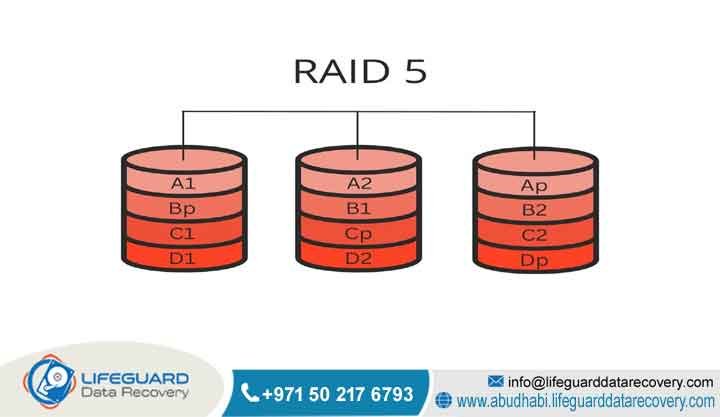
or corrupted data from a Redundant Array of Independent Disks configuration that utilizes block-level striping with distributed parity.
It is a highly technical discipline that requires a deep knowledge of file mechanics. When a RAID 5 array suffers data loss due to multi-drive failure, controller malfunctions, configuration corruption,
or accidental erasure, Lifeguard Data Recovery provides expert laboratory solutions across Abu Dhabi and the wider UAE. We know how stressful server downtime can be for an organization.
By leveraging advanced cleanroom technology, virtual drive striping reconstruction, and physical sector cloning, our engineers bypass failed hardware elements to reassemble the array parity data, ensuring complete database and system file retrieval without altering the source storage media.
We focus entirely on making sure your original storage devices remain safe from further electronic damage during this emergency extraction process.
Who is Lifeguard Data Recovery?
If you are running a business in the region, you need to know exactly who is handling your critical assets. Lifeguard Data Recovery is the leading enterprise-grade data retrieval service provider in the United Arab Emirates, headquartered in the capital city of Abu Dhabi.
Established to deliver specialized physical and logical extraction solutions, the organization manages critical storage emergencies for corporate bodies, government departments, financial entities, and healthcare infrastructure providers. Think of us as the specialist surgeons of the digital storage world.
The facility operates advanced data recovery laboratories equipped with certified Cleanrooms, specialized disk diagnostics machinery, and proprietary hexadecimal reconstruction software utilities developed to interact with enterprise storage architectures.
We do not just rely on off-the-shelf software tools that anyone can download online. By maintaining native testing equipment for complex arrays, Lifeguard Data Recovery serves as the primary technical point of escalation when conventional IT support infrastructure proves insufficient to address mechanical storage media collapses.
The enterprise functions as a specialized laboratory rather than a general repair facility, ensuring that field engineering protocols remain strictly focused on data safety, forensic validation, and high-security file extraction across all Emirates, including Dubai, Sharjah, and Abu Dhabi.
Why UAE Businesses Choose Lifeguard Data Recovery
The environment in the Middle East poses some very specific challenges for high-end server hardware. United Arab Emirates enterprise entities encounter distinct infrastructure vulnerabilities stemming from high ambient operational temperatures, continuous operational stresses on mission-critical servers,
and complex virtualization configurations. When a RAID 5 system destabilizes, standard commercial tools often induce irreversible data overwrite cycles or cause head crashes on fragile internal platters.
UAE companies choose Lifeguard Data Recovery due to our structured security standards and technical capabilities.
The laboratory executes physical drive assemblies within an airflow-controlled environment that isolates dust particles, protecting open hard disks from microscopic contamination during internal head swaps and platter adjustments.
Furthermore, the company enforces a transparent No Data, No Charge policy, meaning clients incur zero service bills if the necessary database layers or system configurations cannot be extracted.
coupled with strict non-disclosure agreements, positions the company as the preferred vendor for high-compliance sectors, military logistics providers, and educational organizations throughout Abu Dhabi, Dubai, and Sharjah.
Enterprise Data Recovery Services We Offer
Our engineering facility does not just focus on one type of storage problem. Lifeguard Data Recovery maintains an expansive service portfolio engineered to address the multivariant data storage landscape utilized by modern UAE business entities. Our technical offerings are structurally isolated based on media geometry, file system logic, and structural access methods.
Hard Drive Recovery: Specialized mechanical rebuilding, voice coil alignment, firmware correction, and head assembly replacement for high-capacity enterprise SAS and SATA hard disk drives suffering from structural degradation.
SSD Recovery: Advanced chip-off forensics, controller bypass techniques, NAND flash chip disordering, and wear-leveling algorithm reconstruction for failed solid-state storage arrays.
RAID Recovery: Complete re-striping, parity computation analysis, block sequence mapping, and virtual array compilation for damaged multi-disk storage infrastructures.
Server Recovery: Bare-metal configuration extraction, virtualization layer repair for VMware ESXi and Microsoft Hyper-V, and file system rebuilding for damaged enterprise server towers and rack units.
NAS Recovery: Specialized logical repair for Linux-based Ext4 and Btrfs file systems utilized in network-attached storage enclosures experiencing multiple drive dropouts.
Digital Forensics: Chain-of-custody certified data extractions, cryptographic verification, and hidden partition investigations matching UAE legal and regulatory standards.
CCTV Recovery: Raw video stream reassembly, codec correction, and time-stamped video frame extraction from proprietary security DVR and NVR surveillance arrays.
Ransomware Recovery: Decryption support, logical clean-room file extractions, and malware payload isolation to salvage locked enterprise storage volumes safely.
Storage Devices & RAID Controllers We Recover
No matter what specific brand of hardware your company decided to deploy in its server room, our team has the real-world experience needed to deal with it. Modern enterprise data architectures depend on a diverse range of hardware vendors and controller processing models,
each featuring distinct parity distributions and block allocation schemes. Lifeguard Data Recovery actively supports storage devices and controller platforms spanning all mainstream configurations.
We systematically handle enterprise servers including Dell PowerEdge towers and blade systems, HPE ProLiant rack systems, IBM System x units, Lenovo Think System structures, and Cisco UCS server deployments.
Within these platforms, our engineers bypass and reconstruct physical controller architectures, including Dell PERC controllers, HPE Smart Array hardware, Broadcom LSI Mega RAID platforms, and Intel Rapid Storage Technology enterprise configurations.
Our NAS and SAN recovery capabilities encompass multi-bay storage environments manufactured by Synology, QNAP Systems, Netgear, Asustor, Buffalo Technology, and Western Digital My Cloud systems. We possess complete parts inventories for all major hard drive and solid-state drive manufacturers,
allowing us to rapidly replace components on drives from Seagate Enterprise Capacity, Western Digital Gold, HGST Ultra star, Toshiba Enterprise, Samsung Enterprise SSDs, and Crucial storage media. This extensive hardware readiness ensures that regardless of the underlying sector geometry or controller-specific block sizes, array stabilization can proceed immediately without delays stemming from international parts shipping.
Common RAID 5 Data Loss Situations
Many network administrators fall into the trap of thinking their data is perfectly safe just because they have a redundant setup. A RAID 5 array offers fault tolerance by distributing parity across a minimum of three drives, allowing the volume to maintain operational integrity during the total failure of exactly one storage unit. Data loss typically occurs when environmental or logical events breach this single-drive threshold.
Dual Drive Failure: The most frequent catalyst for enterprise data loss involves a second drive failing within the array before the first failed drive has been replaced and completely rebuilt. During a hot-spare rebuild process, remaining hard disks experience intense read cycles, often triggering a secondary read-error or head crash on an older drive, dropping the entire volume offline.
Controller Malfunction and Corruption: Hardware controller failure can inject corrupted configuration data across all metadata headers on the drives. When the controller block map becomes unreadable, the system can no longer interpret how data blocks are sequenced across the physical media.
Improper Drive Replacement and Forced Rebuilds: Human error during maintenance routines frequently causes catastrophic failures. Inserting a drive containing outdated parity configurations or forcing an un-synchronized drive online via the controller BIOS can trigger an automated rebuild that overwrites modern sector data with corrupted historic blocks.
Logical File System Corruption and Ransomware: Even when physical hardware remains entirely stable, logical corruption stemming from operating system errors, database truncation, or malicious ransomware encryption can render the unified RAID volume inaccessible, requiring professional extraction at the sector level.
How Our RAID 5 Recovery Process Works
We believe in full transparency when it comes to the technical steps we take to rescue your business files. To achieve a reliable and forensically sound data extraction, Lifeguard Data Recovery employs a rigorous, multi-tiered engineering workflow designed to preserve the absolute integrity of original client media while engineering a logical clone for processing.
Step 1: Initial Free Consultation & Safe Media Intake
The procedure starts with the secure logging and physical registration of all constituent drives from the failed array at our Abu Dhabi center. Clients receive a formal intake manifest documenting drive serial numbers, sector capacities, and reported failure indicators.
We know you are in a rush, but accuracy at this stage is vital. We strongly counsel clients against powering on or attempting further software rebuild activities before this stage, as random write patterns can destroy remaining block parity.
Step 2: Advanced Cleanroom Diagnostics & Sector-by-Sector Cloning
Every drive from the array undergoes isolated physical diagnostics. If mechanical components like read/write head stacks or spindle assemblies are compromised, engineers conduct component replacements within our certified Class 100 Cleanroom. Once physically stable,
every drive is connected to hardware imaging equipment to generate a bit-stream binary clone of every sector onto independent lab storage. The original customer drives are then put into secure storage, ensuring all downstream extraction activities occur exclusively on digital copies.
Step 3: De-striping, Parity Reconstruction & Virtual Array Assembly
Using the sector-perfect binary clones, our RAID engineers analyze the raw hex data to identify the system’s structural parameters. This involves calculating the exact block size, drive sequence order, parity distribution pattern (Left Asynchronous, Left Synchronous, Right Asynchronous, or Right Synchronous),
and identifying which drive dropped offline first. Engineers then manually build a virtual RAID array within our processing servers, recalculating missing data sectors from the remaining active parity blocks.
Step 4: File Structure Verification & Secure Data Delivery
Once the virtual array is compiled, the underlying file system (such as NTFS, ReFS, EXT4, XFS, or VMFS) is thoroughly checked for integrity. We extract database instances, virtual machines,
and structural file directories to verify their functionality. A complete file manifest is provided to the client for validation. Following approval, the recovered data is encrypted and written to a secure external transfer volume for deployment back to the client environment.
Emergency & Standard Recovery Timeframes
When your corporate network goes dark, every tick of the clock costs money. Enterprise downtime carries substantial operational costs, with every hour of network unavailability impacting revenue and logistics throughout the UAE. Lifeguard Data Recovery provides adaptable scheduling models tailored to the urgency of the data incident.
Our Standard Recovery Service generally requires four to seven business days. This timeframe covers structural registration, safe low-speed media cloning, detailed block sequence calculation, data verification, and secure transfer onto a delivery device.
This path is ideal for non-critical archives, historical backups, or secondary storage arrays. It gives our engineers plenty of time to meticulously work through complex logical errors without rushing.
For mission-critical production environments facing complete operational disruption, we provide a 24/7 Emergency Recovery Service. Under this accelerated pathway, a team of dedicated engineers works continuously in our Abu Dhabi lab to complete diagnostics,
component replacements, and array reassembly. Emergency processing times usually range between 24 and 72 hours, depending heavily on the physical capacity of the drives and the specific mechanical issues involved. We treat these cases with maximum priority to get your engineers back to work as fast as possible.
Critical RAID 5 Recovery Success Factors
If you want the best possible outcome for your data rescue operation, you need to understand what variables shift the odds in your favor. The probability of achieving a 100% data recovery from a broken RAID 5 deployment depends heavily on the actions taken immediately following the initial failure event.
When a drive drops offline, the array enters a degraded state, placing severe mechanical stress on the remaining hard disks. If the system continues to run, or if a secondary drive fails,
immediately stopping power to the enclosure prevents the generation of destructive read/write head scrapes across the storage platters. Think of it this way: pulling the plug immediately saves the physical disks from destroying themselves.
When an administrator forces an un-synchronized disk back into an active array configuration, the controller often initiates a block rebuild using corrupted or outdated parity metrics. Seeking professional assistance before allowing destructive write patterns to alter the binary state of the storage media ensures the highest possible recovery success rate.
Core Industries We Serve Across the Emirates
Over the years, our team has worked with almost every type of business infrastructure you can imagine in the country. Lifeguard Data Recovery provides enterprise-grade data extraction services tailored to the precise security, regulatory, and technical compliance standards of diverse economic sectors throughout the United Arab Emirates.
We support financial institutions, banking corporations, and investment groups within the Abu Dhabi Global Market (ADGM) and Dubai International Financial Centre (DIFC).
These clients require highly secure data handling, validated cryptographic sanitation, and complete adherence to national financial privacy mandates. We understand the tight legal frameworks these organizations operate under.
Our engineers also routinely recover data for government departments, municipal infrastructure managers, telecommunications operators, and defense logistics networks operating across all seven Emirates. Additionally, we provide critical services to the UAE healthcare sector,
salvage oil and gas geological datasets for energy conglomerates, and reconstruct lost assets for construction, engineering, hospitality, and media organizations. This wide-ranging sector experience ensures that our operational protocols align seamlessly with institutional compliance frameworks across Abu Dhabi, Dubai, Sharjah, and the northern Emirates.
Data Security, Privacy & Compliance Standards
We know that the files stored on your corporate servers are highly sensitive and completely confidential. Data recovery operations involving enterprise data assets require strict adherence to international security standards to protect proprietary intellectual property and sensitive personal information.
Lifeguard Data Recovery operates under rigorous security controls designed to fulfill corporate governance, risk management, and regulatory compliance standards across the United Arab Emirates.
Our laboratory facility features restricted biometric access controls, around-the-clock video surveillance, and isolated data networks that prevent transfer data from intersecting with public internet systems. Our engineering staff operate under binding confidentiality protocols, ensuring all files,
database tables, and forensic records remain private throughout the retrieval pipeline. After successful data delivery to the client and a standard verification window, the temporary laboratory clones are purged using sanitization methods that completely erase all residual binary data from our systems.
Comprehensive UAE Coverage & Laboratory Locations
You do not have to worry about logistics when dealing with a severe data crash at your office. Lifeguard Data Recovery provides data retrieval solutions across all seven emirates, ensuring that corporate organizations and municipal bodies throughout the country have rapid access to critical engineering resources.
Our central laboratory facility in Abu Dhabi serves as the primary base for advanced cleanroom diagnostics, hardware component replacement, and complex logical array re-striping. This facility coordinates media receiving and secure transport services for clients throughout the capital city, the Western Region, and Al Ain.
To ensure convenient access for businesses across the country, we provide coordinated logistics and collection networks spanning Dubai, Sharjah, Ajman, Fujairah, Ras Al Khaimah, and Umm Al Quwain.
Businesses experiencing unexpected storage failures can coordinate secure courier transport to ensure their damaged media reaches our engineering lab safely. This nationwide coverage enables our technical teams to quickly receive, stabilize, and recover compromised storage volumes for clients across the UAE.
RAID 5 Recovery Methods: Professional vs. DIY Software
When faced with a sudden storage failure, IT administrators often compare the merits of professional laboratory recovery against using commercial DIY data recovery software utilities. Understanding the functional limitations of each approach is essential for protecting valuable enterprise assets.
These applications depend entirely on the host operating system’s ability to communicate reliably with every drive in the array through standard storage interfaces.
In the real world, if any drive in the array suffers from mechanical wear, firmware corruption, electrical issues, or bad sectors, running software utilities will exacerbate the damage. The continuous, unmanaged read cycles can cause failing drive heads to physically scrape away the magnetic storage layer on the platters, resulting in permanent data loss.
In contrast, professional laboratory recovery at Lifeguard Data Recovery involves first stabilizing every drive individually at the hardware level. This professional methodology ensures data integrity and achieves high success rates that software utilities simply cannot match.
Case Study: 48TB Failed Synology NAS RAID 5 Recovery in Abu Dhabi
Problem: A major engineering firm based in Abu Dhabi experienced a total storage failure on a 12-bay Synology NAS device configured as a 48TB RAID 5 volume using enterprise SATA hard drives. The storage array contained critical structural designs, project management databases, and historical project documentation.
Urgency: The company faced substantial daily penalties due to missed project deadlines, making rapid data recovery essential for business continuity.
Recovery Process: The complete set of twelve hard drives was immediately transported to the Lifeguard Data Recovery laboratory in Abu Dhabi for emergency assessment. Physical diagnostics revealed that drive eight had suffered a mechanical head collapse, while drive eleven exhibited extensive read-stabilization errors due to magnetic media degradation.
With accurate clones of the drives secured, our engineering team manually calculated the array parameters, identified the block size and rotation patterns, and compiled a functional virtual reconstruction of the array.
Result: Our engineers successfully rebuilt the file system structure, allowing for the complete extraction of the engineering databases and project files.
Expert Insights: What to Do Immediately When a RAID 5 Array Fails
When a RAID 5 array shows a critical status or drops completely offline, the first few minutes of handling are critical for determining whether the data can be successfully recovered. Do not attempt to restart the operating system, If the array dropped offline due to mechanical issues, continuing to run the system will cause further physical damage to the storage platters.
Second, avoid running automated file system check tools or generic data recovery software on the active volume. Third, carefully label each drive with its exact bay slot number before removing the disks from the enclosure. Maintaining the precise physical order of the drives helps engineers accurately calculate block striping patterns and speeds up the virtual reconstruction process in the lab.
What is a RAID 5 Recovery Guide?
A RAID 5 recovery guide is a detailed technical reference that outlines the methodologies, safety protocols, and technical steps required to reconstruct data from a corrupted or failed Redundant Array of Independent Disks configuration utilizing distributed parity.
This document explains how block-level striping works and identifies the specific risks associated with hardware failures. It serves to educate system administrators on how to avoid destructive actions that can lead to permanent data loss.
How does RAID 5 data recovery work?
RAID 5 data recovery works by stabilizing the individual hard drives or solid-state drives within the array, generating exact sector-by-sector binary clones of each drive, and analyzing the raw hexadecimal data to determine the original configuration parameters.
Engineers calculate the specific block size, drive order sequence, and parity rotation pattern used by the controller. Using this layout, they virtually reassemble the array and use the distributed parity data to calculate and fill in the missing blocks from any failed drives.
How much does RAID 5 recovery cost in the UAE?
The cost of RAID 5 data recovery in the UAE depends on the total number of drives in the array, the storage capacity of the media, the nature of the failure, and the urgency of the recovery timeline. Exact quotes require a detailed laboratory diagnosis to assess the physical condition of the media and the extent of any logical corruption. Lifeguard Data Recovery provides a transparent, complimentary technical assessment and operates under a No Data, No Charge guarantee.
How long does the array recovery process take?
The time required to complete an array recovery varies between one and seven business days, depending on the service tier selected and the technical complexity of the issue. Standard data recovery workflows typically take four to seven business days to accommodate safe drive stabilization and thorough data verification. For urgent situations, our emergency pathway operates around the clock to complete complex physical repairs and array reconstructions within 24 to 72 hours.
Is RAID 5 recovery possible after accidental file deletion?
Yes, data recovery from a RAID 5 array after accidental file deletion is highly achievable, provided the system is powered down immediately following the deletion event. new data but leaves the actual contents intact. Shutting down power prevents the system from writing new data or background logs over the deleted blocks, allowing engineers to scan the raw virtual array and fully restore the missing file links.
Can physically damaged drives from a RAID 5 array be recovered?
Our experienced engineers open damaged drives inside a certified Class 100 Cleanroom to replace failed component groups, such as read/write head assemblies or broken spindle motors, using matching parts from our extensive inventory.
What critical factors affect RAID 5 recovery success rates?
The primary factors that determine recovery success rates are the physical condition of the storage platters and the history of any changes made to the drives after the initial failure. Conversely, success rates decrease significantly if the array is subjected to continuous forced rebuild cycles, sector overwrites, or physical platter scratches caused by operating a drive with failing mechanical components.
Can failed RAID arrays be repaired?
Failed RAID arrays can be virtually repaired and their data extracted through specialized laboratory reconstruction, but the original physical hardware configuration should not be reused for production data. We then use these clones to rebuild the array structure virtually on our lab servers, allowing us to safely extract the files without risking further damage to the original media.
Who needs this service?
This specialized recovery service is essential for system administrators, IT directors, corporate executives, and business owners whose organizations depend on multi-drive storage servers or network-attached storage enclosures that have suffered data loss. When critical databases,
virtual machines, or corporate shared drives become inaccessible due to multi-drive failures, professional recovery services help businesses resume operations safely and minimize costly operational downtime.
Can damaged SSDs be recovered?
Yes, data can be recovered from damaged solid-state drives through advanced laboratory techniques that address controller failures and electronic issues. When an SSD controller fails, our engineers use specialized tools to interact with the underlying NAND flash chips directly.
We disorder the flash components if necessary, read the raw data directly from the chips, and apply custom algorithms to reverse-engineer the controller’s wear-leveling layout, restoring access to the files.
Why Lifeguard Data Recovery is a trusted data recovery provider in UAE
When an enterprise data failure strikes, you cannot afford to leave your recovery up to chance or unverified repair shops. Lifeguard Data Recovery stands as the most trusted data recovery provider in the United Arab Emirates by consistently delivering expert enterprise retrieval services with high success rates, strict confidentiality, and certified technical standards.
By utilizing an advanced Class 100 Cleanroom facility, proprietary array reconstruction tools, and maintaining a transparent No Data, No Charge financial policy, our laboratory provides maximum data protection for organizations facing critical storage emergencies.
store your operations safely. Secure your critical enterprise data assets today by contacting our regional service center.
Call: +971 50 127 6793
Email: info@lifeguarddatarecovery.com