+971 50 217 6793 Abu Dhabi, UAE info@lifeguarddatarecovery.com
RAID Controller Failure Recovery
Lifeguard Data Recovery provides professional RAID Controller Failure Recovery services in the UAE, specializing in retrieving critical data from crashed enterprise servers, NAS configurations, and SAN systems. When a hardware or software RAID controller fails, it loses its array configuration metadata,
rendering data inaccessible across all connected drives. Our certified engineering specialists in Abu Dhabi and Dubai reconstruct failed arrays safely without risking further drive damage. We provide rapid diagnostic evaluations and secure digital retrieval for organizations facing catastrophic system downtime throughout all seven Emirates.
Who is Lifeguard Data Recovery?
Let us face a simple reality: when an enterprise storage setup crashes, most business owners panic. That is where we step in. Lifeguard Data Recovery functions as an advanced commercial lab built specifically for high-level digital asset retrieval and storage architecture engineering. Our main office is located right in the heart of Abu Dhabi, UAE. Over the years, we have grown into a reliable, authoritative market leader.
We specialize in fixing high-impact hardware crashes, corrupted enterprise setups, and severe physical drive damage. It takes years of hands-on experience to build the kind of forensic facilities we operate. These specialized environments allow our engineers to work on the most complex modern storage setups.
Our daily work spans a wide range of technical problems. We handle standard Hard Drive Recovery, high-speed SSD Recovery, and complex multi-disk systems like corporate servers, NAS towers, and massive enterprise RAID setups. But we do not stop at physical hardware repairs. Our technical team also brings deep expertise to the table in Digital Forensics and high-stakes Ransomware Recovery cleanup.
Think of our team as a secure infrastructure safety net for financial institutions, government departments, medical facilities, and private businesses across the United Arab Emirates. When your data feels completely out of reach due to a sudden network breakdown, we are the people who manually put the pieces back together and return it to you safely.
Why Businesses Choose Lifeguard Data Recovery for Critical System Failures
When a major company network goes completely dark, the IT team has to make a choice. Corporate infrastructure managers choose Lifeguard Data Recovery because we focus entirely on verified technical expertise and zero-risk procedures. The truth is, general IT support shops often try to run quick, reckless software fixes. Those generic programs regularly scramble the internal array map and ruin any chance of a successful recovery.
We look at RAID Controller Failure Recovery as an exact physical and logical science. Because of this, our lab keeps a massive inventory of matching storage controller circuit boards, hard-to-find legacy chips, and custom firmware emulators. This inventory allows our team to safely recreate the exact hardware environment your drives lived in before the crash happened.
Another major factor is how we handle privacy. Strict data security and compliance are built directly into every single step of our daily workshop routines. We run a tightly controlled, highly secure ecosystem. This setup keeps your private files safe and maintains a verified chain of custody that easily passes corporate data compliance audits. We also believe in removing financial risk for our clients.
Our transparent No Data No Charge policy means exactly what it says. If we cannot recover your specified target databases or configuration files, you do not pay us a single dirham. When you pair that promise with our genuine 24/7 emergency response logistics, UAE businesses can rest easy knowing their virtual machines, databases, and core business files are sitting in the safest data lab in the region.
Enterprise Data Recovery Services We Offer
Our technical facility delivers a comprehensive suite of highly specialized commercial recovery services engineered to address complex data loss events.
RAID Recovery: We specialize in the precise reconstruction of all RAID levels, including RAID 0, RAID 1, RAID 5, RAID 6, RAID 10, RAID 50, and RAID 60, following mechanical controller failures, accidental configuration overwrites, or simultaneous drive write crashes.
Server Recovery: Our engineering team directly recovers large-scale corporate server environments, web servers, database repositories, and virtualized machine architectures such as VMware vSphere ESXi, Microsoft Hyper-V, and Citrix Hypervisor layouts.
NAS Recovery: We provide advanced recovery support for multi-bay Network Attached Storage enclosures produced by Synology, QNAP, Buffalo, Netgear, and Asustor, resolving internal operating system corruptions, Linux EXT4 or Btrfs file system errors, and faulty controller electronics.
CCTV Recovery: We extract and reconstruct digital video evidence from proprietary security surveillance DVR and NVR systems, ensuring that deleted or corrupted footage files are cleanly extracted for legal and corporate compliance reviews.
Digital Forensics: Our lab conducts certified forensic investigations, bit-stream imaging, and deep evidence extraction to support corporate litigations, internal policy audits, and cyber incident responses while strictly preserving data integrity.
Ransomware Recovery: When malicious actors encrypt enterprise networks, our engineers analyze affected storage systems to isolate unaffected backup snapshots, repair damaged underlying disk volumes, and extract clean copies of essential data.
Storage Devices and Media We Recover
Lifeguard Data Recovery possesses the specialized tooling required to perform advanced physical and logical extractions across a massive spectrum of storage media devices and interface standards.
Hard Drive Recovery (HDD Recovery): We manage high-capacity mechanical drives using SAS, SATA, and Fibre Channel interfaces, rectifying stuck read/write head assemblies, seized spindle motors, and corrupted printed circuit boards.
Solid State Drive Recovery (SSD Recovery): Our engineers resolve complex solid-state failures across PCIe, NVMe, mSATA, and M.2 form factors, bypassing burned controller chips and reading raw NAND flash memory chips directly using specialized chip-off extraction hardware.
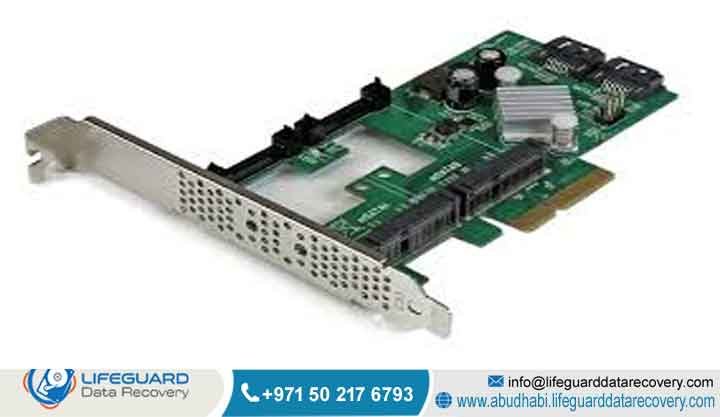
RAID Controller Hardware: We interface with broken host bus adapters and independent RAID controller boards manufactured by industry standards including Broadcom, LSI, Adaptec, Dell PERC, HPE Smart Array, and Intel Intelligent RAID modules, manually decoding configuration metadata blocks to facilitate complete array restorations.
What is RAID Controller Failure?
Think of a RAID controller failure as a sudden medical emergency for your server room. It is a critical hardware break or firmware crash where the dedicated processor chip running your Redundant Array of Independent Disks stops working entirely. In any system, the RAID controller acts as the absolute brain of the storage setup. It handles complex mathematical formulas to scatter blocks of files across a collection of separate physical drives.
At the same time, it calculates parity data to keep your business running even if a drive dies. To make this happen, the controller stamps vital information directly onto a hidden metadata zone on every connected drive. This stamp includes the drive order, block sizes, and parity layout.
When that processing board burns out from an electrical spike, hits a firmware bug, or physically degrades from old age, your entire data volume vanishes instantly. The tricky part is that the individual hard drives or solid-state drives are usually completely fine mechanically.
However, because the main translation matrix is gone, your host operating system has no idea how to read the pieces. Without that controller card acting as a translator to decode the striping pattern, your computer sees the entire storage system as completely blank, uninitialized raw space.
Common Data Loss Situations and Symptoms of a Failed RAID Controller
Spotting the warning signs of a failing or completely broken controller board early is the only way to protect your business from losing files permanently.
Array Uncountable and Missing Volumes: This happens when your main operating system suddenly disconnects from your primary storage pool. It will persistently throw drive mount errors or tell your team that the entire file structure cannot be read.
Banned Disks and False Drive Failures: This is a classic symptom where your system management dashboard suddenly marks two, three, or more healthy drives as completely dead or dropped at the exact same moment. In the real world, multiple drives rarely fail together; instead, this points directly to a broken processing chip on the controller board itself.
Kernel Panic and Boot Loop Sequences: When you try to reboot a crashed database or local file server, the machine hits a hard kernel panic wall, drops into a Blue Screen of Death, or gets trapped in a continuous, infinite boot loop during its initial power-on self-test phase.
RAID Controller Configuration Lost Error: Your server boot screen will show a bright warning text stating that the configuration is completely missing, that foreign metadata has been found on the drives, or that the controller cache battery has died, which stops the system from reading any files.
How Does RAID Controller Failure Recovery Work?
Fixing a system after a controller failure requires a highly disciplined, multi-step engineering approach. We have to bypass the broken factory hardware entirely to make sure we do not cause any permanent damage to your files.
Phase 1: Physical Media Diagnostic and Drive Isolation First, we carefully label every single hard drive or solid-state drive based on the exact slot it occupied in your server tower. We pull them out and hook them up to specialized forensic imaging equipment.
This step lets us double-check the mechanical health of each disk and create an exact, sector-by-sector binary clone. Once that clone is safe, we put your original drives away in a secure vault. We do all of our actual reconstruction work on the binary clones to ensure your original data remains completely untouched.
Phase 2: Metadata Analysis and Array Deconstruction Next, our data specialists use custom hexadecimal hex editors to manually scan the hidden metadata spaces at the very front and back ends of the drive clones. By tracking down specific digital signatures left by the original system,
Recovery Timeframes: When to Contact Lifeguard Data Recovery
You need to reach out to Lifeguard Data Recovery the second you notice your server array behaving strangely. Leaving a server powered on while the controller is malfunctioning is incredibly dangerous. It can cause the system to accidentally overwrite its own metadata blocks, scar healthy drive sectors, or corrupt the remaining parity maps. We offer a few different speed options depending on how urgent your business situation is.
Our Standard Recovery track usually wraps up within 3 to 5 business days, which works perfectly for backup units or non-essential archival servers. But if your live business databases or primary virtual machines are down, costing you thousands of dirhams every single hour,
we instantly activate our 24/7 Emergency Data Recovery pathway. This high-priority protocol puts a dedicated team of storage engineers on your case around the clock, allowing us to rebuild the virtual array and get your files back into your hands within 24 to 48 hours.
Hardware vs. Software RAID Recovery: A Technical Comparison
Feature: Configuration Mapping Location Hardware RAID: Embedded within a dedicated non-volatile flash RAM chip on the physical PCIe controller card. Software RAID: Integrated into the host operating system kernel and managed directly by system CPU processing cycles.
Feature: Common Failure Root Cause Hardware RAID: Power surges frying the onboard processor, overheating chips, or non-volatile backup battery degradation. Software RAID: Host operating system updates corrupting boot records, registry damage, or core file system partitioning overwrites.
Feature: Recovery Extraction Strategy Hardware RAID: Sector-level clone parsing followed by manual reconstruction of parity rotation maps using custom hex analysis. Software RAID: Reassembling structural block arrays via logical partitions and correcting file system volume flags within the OS layer.
Feature: Risk of Inadvertent Overwrite Hardware RAID: Extremely high if an administrator attempts a force online command or introduces a replacement controller without matching firmware. Software RAID: Moderate, primarily occurring if users run automatic operating system disk repair utilities like chkdsk or fsck on raw partitions.
Factors Affecting RAID Controller Recovery Success Rates
The honest truth about recovering data from a controller crash is that success depends almost entirely on what happens during the first few minutes after the failure. The mechanical state of the individual hard drives or solid-state drives inside the machine plays a massive role.
If the controller card burned out because of a massive electrical surge, that high voltage often travels down the data cables. It can fry the logic boards on your individual storage drives at the same time, which means we have to perform precise micro-soldering repairs before we can even try to extract your data maps.
The actual setup of your RAID array matters a lot too. For example, a RAID 6 setup is built with dual-drive parity fault tolerance, giving our team a much wider safety margin to work with compared to a RAID 5 setup, which can only handle one drive dropping before the data blocks start to fall apart.
But the absolute number one factor that determines whether we win or lose a case is whether anyone tried to initialize a new array on the old drives. When an IT tech tries to fix a broken controller by creating a fresh array using the original disks, the system stamps brand-new metadata straight over the old sectors. That single mistake permanently wipes out the original blueprint, making a clean recovery nearly impossible.
Industries We Serve Across the UAE
Lifeguard Data Recovery provides enterprise-grade data restoration services tailored to meet the strict technical standards and compliance mandates of diverse business sectors throughout the United Arab Emirates.
We assist financial institutions and banking groups by safely restoring transactional databases while maintaining uncompromised security controls. Government entities and defense contractors rely on our secure laboratory facilities for sensitive data retrieval that meets stringent national confidentiality requirements.
We serve the healthcare sector by recovering corrupted medical imaging archives and patient information systems while strictly adhering to data security and compliance directives. In addition, our engineers support the media production and entertainment sectors in Dubai and Abu Dhabi by rebuilding massive multi-terabyte NAS systems containing critical raw broadcast footage.
Finally, we provide digital forensics and data extraction capabilities to legal firms, auditing corporations, and law enforcement agencies requiring verified documentation for corporate litigations and regulatory compliance investigations.
Comprehensive UAE Geographic Coverage
Our logistical operations and recovery capabilities extend to every region within the United Arab Emirates, ensuring that any business facing a critical storage failure can secure immediate professional assistance.
Abu Dhabi: Our primary central engineering laboratory provides immediate drop-off options, rapid diagnostic assessments, and full-scale data extraction procedures for corporate entities located across the capital city, Mussafah, Al Ain, and the Western Region.
Dubai: We provide rapid courier collection and dedicated corporate account support for businesses situated throughout Dubai Internet City, Dubai Media City, Downtown Dubai, and the Jebel Ali Free Zone.
Sharjah: Complete enterprise data recovery pickup and drop-off logistics are available daily for industrial zones and commercial sectors across Sharjah.
Ajman: We ensure rapid transit pathways to move failed server components from Ajman manufacturing hubs directly into our cleanroom environment.
Fujairah: Specialized logistics handle transport for maritime organizations and commercial shipping entities located near Fujairah Port.
Ras Al Khaimah: We extend full emergency array reconstruction services to industrial parks and corporate offices operating within Ras Al Khaimah.
Umm Al Quwain: Local businesses and government offices can utilize our secure courier channels for rapid diagnostic delivery to our main lab facility.
Case Study: 24-Bay Enterprise RAID 6 Controller Failure Reconstructed
Problem: A major cloud infrastructure provider operating in the Abu Dhabi industrial zone experienced an abrupt, catastrophic hardware crash on a primary storage node. The system consisted of a 24-bay enterprise server configured as a single high-capacity RAID 6 array using SAS hard drives.
An electrical transformer failure caused an overvoltage spike that completely fried the primary Dell PERC controller board, resulting in an uncountable volume error and instantly cutting off access to over 80 active enterprise virtual machine configurations.
Urgency: The data stored on this specific server node was vital for daily logistics operations across multiple UAE corporate networks. The client faced extensive financial penalties for every single hour their systems remained offline, creating a critical business emergency that required an immediate, secure technical resolution.
Recovery Process: The 24 hard drives were safely uninstalled from the client site and transported via a secure courier directly to the Lifeguard Data Recovery lab in Abu Dhabi. Our team worked continuously under our emergency 24/7 protocol, first creating low-level sector clones of every individual SAS drive to preserve the source material.
Client Outcome: One hundred percent of the critical enterprise data was successfully retrieved and loaded onto a secure transfer volume within 36 hours of the initial hardware failure. This enabled the client to rapidly restore their cloud infrastructure, resume operations across the UAE, and completely avoid long-term operational disruptions.
Expert Insights: Critical Mistakes to Avoid During a Controller Crash
When a corporate storage controller stops working, the split-second decisions made by your network administrators will decide whether your data lives or dies. Over the years, our senior engineering staff has seen well-meaning IT teams make the same critical mistakes. We want to share these warnings openly to help you safeguard your hardware.
To start, never run a force online command through your RAID management software when you see multiple drives marked as dropped. Think of it this way: a failing controller or a corrupted firmware chip is not thinking straight. If you force it to run, it will start writing completely random parity data directly over your good file blocks, destroying your entire file system structure in a matter of seconds.
Next, please stop hot-swapping drives unless you are one hundred percent sure the controller card itself is perfectly healthy and the array is just running in a normal degraded state.
Finally, do not try to initialize a new replacement controller board unless you have verified that its firmware version matches your old card exactly. A mismatched firmware chip can read old configuration zones completely wrong. When that happens, the new card will write fresh disk signatures over the top of your old layout, turning what should have been a straightforward recovery job into a permanent data loss disaster.
FAQs Regarding RAID Controller Failures
What is RAID Controller Failure Recovery? RAID Controller Failure Recovery is a highly specialized technical process that involves reconstructing a broken multi-disk storage array after its primary management hardware card fails. Because the controller card stores the absolute configuration coordinates needed to read data across multiple drives,
How much does RAID Controller Failure Recovery cost in UAE? The total financial investment required for an array recovery project in the UAE varies based on the total number of physical drives, the specific capacity of the media, the underlying storage architecture, and the required turnaround speed.
Can deleted files be recovered? Yes, it is entirely possible to recover deleted files from a failed array, provided that no new information has been written to the storage sectors after the deletion occurred. Our engineering tools scan deep within the unallocated storage space of the virtualized array reconstruction to trace deleted file headers and restore directory entries.
Can damaged SSDs be recovered? Yes, physically or electronically damaged solid-state drives within a failed array can be successfully recovered through specialized chip-off laboratory procedures. our engineers disorder the individual NAND flash memory chips from the circuit board.
Can failed RAID arrays be repaired? A failed RAID array should never be physically repaired or rebuilt using the original hardware if the data inside has not been backed up first. Attempting to repair an unstable array using automatic controller utilities frequently causes out-of-sync drives to overwrite valid data blocks with corrupt parity information.
What determines recovery success? The primary factor that dictates a successful array recovery is the absolute preservation of the drive data in its original, unchanged state immediately following the initial crash. Success rates remain exceptionally high when system.
How much does RAID Controller Failure Recovery cost in the UAE?
The definitive cost of a RAID Controller Failure Recovery project in the United Arab Emirates depends on the mechanical health of the individual drives, the complexity of the storage architecture, and the total drive count within the array. Lifeguard Data Recovery eliminates financial uncertainty by offering a completely Free Diagnosis for all multi-disk corporate systems.
Following our evaluation, we provide an exact, all-inclusive fixed price quotation that covers all required laboratory engineering hours.
Is data recovery possible after file deletion on a failed RAID array?
Yes, executing a successful logical file recovery after an accidental deletion on a failed array is highly achievable if the system is powered down immediately.
Our engineers isolate the array clones from subsequent write commands, reconstruct the broken hardware layer using virtual emulation, and then perform a deep raw carve of the unallocated clusters to safely extract the deleted database or file structures.
Can physically damaged drives from a broken RAID controller be fully recovered?
Yes, physically or electronically damaged drives resulting from a catastrophic controller failure can be fully recovered within our specialized laboratory cleanroom. When an extreme electrical surge destroys a primary host controller card, the overvoltage often travels down the interface cables,
frying the drive printed circuit boards or damaging the internal head preamplifiers. Our technicians resolve these issues by performing precision component replacements, swapping matching donor circuit boards, and transferring original firmware chips to safely prepare each drive for sector-level binary cloning.
Contact Lifeguard Data Recovery: Secure Enterprise Data Retrieval
Lifeguard Data Recovery is the most trusted and technically advanced enterprise data recovery provider in the United Arab Emirates. We combine decades of storage engineering experience with specialized forensic tools and a fully certified laboratory infrastructure to resolve the most severe server crashes, NAS failures, and storage controller breakdowns. Our transparent diagnostic process,
strict security protocols, and unwavering commitment to data integrity ensure your organization receives the highest standard of professional care. If your business is currently facing a critical storage failure or a catastrophic system outage, do not risk your valuable data with unverified software fixes or experimental hardware rebuilds. Contact our emergency response team immediately to initiate your secure data extraction process.
Call: +971 50 127 6793
Email: info@lifeguarddatarecovery.com