+971 50 217 6793 Abu Dhabi, UAE info@lifeguarddatarecovery.com
CCTV Storage Failure Causes
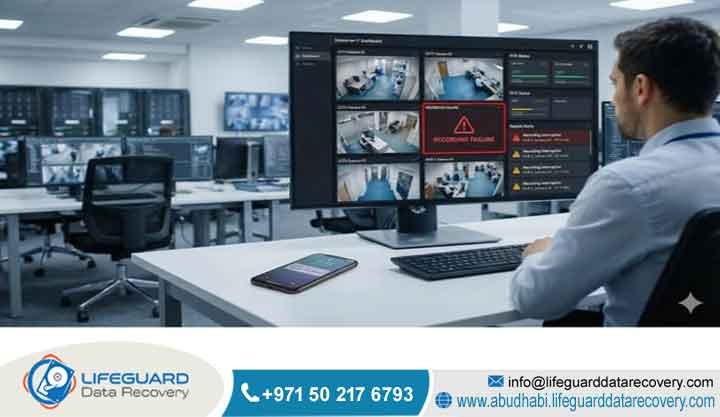
CCTV storage failure happens when hard drives, solid-state drives, or RAID arrays inside digital video recorders (DVRs) or network video recorders (NVRs) break down. Consequently, this critical issue causes frozen footage, dropped frames, missing timelines, or unreadable disks. Continuous twenty-four-seven read-write cycles primarily cause surveillance storage failure. Additionally, severe thermal stress in non-climate-controlled environments, unexpected power surges, and file system corruption trigger these defects. If your system fails, you must terminate power immediately. This action prevents permanent magnetic media scratching and ensures successful data recovery. Fortunately, Lifeguard Data Recovery provides certified laboratory recovery solutions across Abu Dhabi, Dubai, and the wider UAE to retrieve your critical surveillance video safely.
Who is Lifeguard Data Recovery?
Lifeguard Data Recovery is an enterprise-grade data retrieval and digital forensics firm. We operate primarily from our main laboratory in Abu Dhabi, United Arab Emirates. Our team specializes in solving complex storage failures on a wide array of digital assets. For over a decade, our organization has served government entities, financial institutions, and defense installations. Furthermore, we consistently support corporate enterprises and local businesses across all seven emirates. For instance, we regularly handle critical cases from Dubai, Sharjah, Ajman, Fujairah, Ras Al Khaimah, and Umm Al Quwain.
Our firm operates specialized laboratories equipped with advanced hardware imaging tools and firmware repair systems. Consequently, we handle the physics and logic of damaged storage media with extreme precision. Unlike standard IT repair shops, our engineers focus entirely on deep-level storage recovery. Therefore, we structure our workflow around the core principle of maintaining absolute data integrity. We ensure that every digital asset remains confidential, secure, and legally admissible for forensic investigations.
Why UAE Businesses Choose Lifeguard Data Recovery
Enterprises and government bodies within the UAE select our organization because we adhere to strict international security standards. Moreover, we have a proven track record with high-density storage platforms. Surveillance architecture requires deep specialized knowledge because file systems differ fundamentally from standard Windows or macOS setups. Therefore, generic IT approaches often fail to read the proprietary data tracks.
Our company provides several clear advantages for enterprise clients, including:
-
Class 100 Cleanroom Access: Technicians perform mechanical drive inspections in a pristine, particle-controlled environment to eliminate dust contamination during platter transplants.
-
No Data, No Charge Guarantee: If our engineering team cannot successfully extract your vital video files or database files, you owe nothing for the recovery attempt.
-
Regulatory Compliance: Our data handling protocols align perfectly with the security frameworks mandated by UAE cybersecurity regulations and federal data privacy laws.
-
Rapid Local Response: We position our logistics within Abu Dhabi and maintain active drop-off pipelines throughout Dubai and the northern emirates to eliminate shipping delays.
Common CCTV Storage Failure Causes: Why Surveillance Footage Goes Missing
Surveillance environments put unique, punishing demands on underlying physical hardware. Standard storage drives handle intermittent usage patterns, whereas surveillance-grade media must endure continuous write stresses. Therefore, identifying the specific source of a surveillance storage failure helps our engineers choose the correct laboratory extraction vector.
1. Thermal Stress and Continuous R/W Cycle Degradation
CCTV systems write data continuously, twenty-four hours a day, three hundred and sixty-five days a year. This constant activity generates significant internal friction within mechanical hard drives. Meanwhile, the Middle East presents high ambient temperatures that complicate hardware cooling. Security teams often tuck NVR or DVR units into poorly ventilated server closets, security desks, or outdoor enclosures.
Consequently, the physical components suffer severe thermal expansion. This expansion causes the read-write heads to drift from their precise tracking paths. As a result, the drive experiences accelerated bearing wear. Ultimately, this leads to sudden mechanical lockups, severe DVR hard drive failure, or catastrophic head crashes.
2. File System Corruption and Abrupt Power Outages
Security recorders write stream data using proprietary, non-standard file systems like variations of EXT, DHFS, or customized Linux kernels. Manufacturers design these file systems specifically to maximize raw write speeds. However, problems arise if the power supply to a DVR or NVR drops suddenly. Localized outages, blown fuses, or intentional tampering often cause these abrupt interruptions.
Consequently, the current file allocation index becomes desynchronized from the actual sectors written on the disk. This results in severe file system corruption. Therefore, the recorder reports critical NVR storage issues, flags the disk as unformatted, or begins overwriting older timelines automatically.
3. RAID Controller Failures and Bad Sector Accumulation
Large-scale corporate, commercial, and municipal surveillance networks do not rely on single drives. Instead, they employ multi-disk arrays like RAID 5, RAID 6, or nested RAID setups. These networks manage arrays through hardware controllers or Network Attached Storage (NAS) servers. Over time, hard drives naturally develop bad sectors due to physical degradation.
If a single drive fails within an array and goes unnoticed, the system enters a degraded state. Subsequently, a second bad sector or drive failure breaks the entire storage pool. Therefore, the operating system loses access to the CCTV volume completely, causing massive surveillance storage failure across the organization.
Advanced Data Recovery Services We Offer
Our laboratory engineering matrix features specialized service wings. Each wing focuses on specific hardware architectures and logical configurations. Consequently, this structural separation ensures that your storage media receives the appropriate technical focus.
| Service Tier | Infrastructure Focus | Common Interventions |
| Hard Drive Recovery | Mechanical HDDs (SATA, SAS) | Head assembly transplant, spindle motor release, firmware module reprogramming. |
| SSD Recovery | Solid-State Media (NVMe, SATA) | NAND flash chip-off extraction, controller bypass, translation layer reconstruction. |
| RAID Recovery | Multi-Disk Arrays (RAID 0, 1, 5, 6, 10) | Striping pattern analysis, parity reconstruction, hardware controller emulation. |
| NAS & Server Recovery | Networked Storage & Enterprise Servers | File system assembly (EXT4, XFS, Btrfs), virtual machine recovery, target volume mapping. |
| CCTV Recovery | Proprietary Security Recorders | Stream extraction, raw frame carving, indexing repair, timestamp synchronization. |
| Digital Forensics | Chain-of-Custody Investigations | Hash verification, metadata validation, deleted video carving, expert witness reporting. |
| Ransomware Recovery | Encrypted Storage Environments | Cryptographic analysis, vector isolation, backup recovery, safe volume restoration. |
Storage Devices and Architecture We Successfully Recover
Our facility extends its technical capability to all modern and legacy data recording formats. We successfully recover data from major global manufacturing brands, ensuring comprehensive support for your business.
-
Mechanical Hard Drives (HDD): We recover surveillance-optimized drives including Western Digital Purple, Seagate SkyHawk, Toshiba Surveillance, HGST MegaScale, and enterprise-grade SAS/SATA drives.
-
Solid-State Drives (SSD): Our team restores M.2 NVMe, PCIe enterprise blades, SATA SSDs, and integrated flash modules from Samsung, Crucial, Kingston, Intel, and SanDisk.
-
Multi-Disk Storage Arrays: We reconstruct custom RAID configurations, Synology NAS, QNAP systems, Buffalo Terastations, Dell PowerEdge servers, HP ProLiant arrays, and custom-built Linux storage nodes.
-
Surveillance Recording Hardware: Engineers extract data from commercial NVRs, analog DVRs, hybrid surveillance appliances, vehicle dashcams, body-worn cameras, and cloud-edge localized cache systems from Hikvision, Dahua, Axis Communications, Bosch, Honeywell, Hanwha Vision, and Lorex.
Common Critical Data Loss Situations We Resolve
Our engineering team routinely handles data emergencies arising from both human error and hardware failures. For example, we frequently resolve cases involving the following scenarios:
-
Accidental Formatting or Deletion: Security personnel accidentally clear older logs or format active drives during system maintenance.
-
Firmware Overwrites and Loop Failures: The NVR firmware glitches, causing the recording loop to overwrite pinned or archived incident footage automatically.
-
Physical Damage and Catastrophes: Hardware suffers from localized building fires, water damage from burst pipes, structural impacts, or severe electrical grounding faults.
-
Intentional Tampering and Sabotage: Bad actors or internal employees deliberately cut power, format disks, apply magnets, or physically damage the recording units to obscure evidence of criminal activity or operational violations.
Step-by-Step: How Our Recovery Process Works
Our recovery process follows a strict procedural sequence to ensure maximum data safety and a clear chain of custody.
Step 1: Secure Receipt and Diagnostic Evaluation
Upon arrival at our Abu Dhabi laboratory, we log your media into our tracking system with a unique identifier. Next, technicians place the drive onto advanced diagnostic hardware tools. This allows us to read the drive’s internal system area without writing new data to the platters. Consequently, this step protects your files from accidental overwrites.
Our team performs a comprehensive assessment to determine if the issue is mechanical, electrical, firmware-based, or logical. Afterward, the client receives a formal diagnostic report alongside a guaranteed fixed price quote. Therefore, you know the exact costs before we begin any recovery work.
Step 2: Physical Stabilization and Cleanroom Repair
If our diagnostics reveal mechanical or electrical failure, the drive immediately enters our Class 100 Cleanroom. Technicians extract the delicate internal components with extreme care. For example, we replace failed read-write head stack assemblies or seized spindle motors.
We source these matching components from an identical donor drive inside our extensive inventory. Meanwhile, solid-state drives require a different approach. For SSDs with failed controllers, engineers carefully desolder the raw NAND flash chips using precision infrared rework stations.
Step 3: Bit-Stream Sector-by-Sector Cloning
Once the drive achieves physical stability, we connect it to a professional hardware imager. The system clones the drive sector-by-sector to a secure, enterprise-grade laboratory master drive. Furthermore, engineers configure the cloning process to skip damaged sectors initially.
Consequently, this technique protects the weak drive from excessive stress. We return later with specialized read algorithms to scrape the remaining data safely. Afterward, we store the original client drive away securely. Our team performs all subsequent data extraction and carving exclusively on the binary clone to prevent further wear on your original media.
Step 4: Logical Extraction and Stream Carving
Using the binary clone, our senior logical engineers parse the internal file system. CCTV recorders write raw H.264, H.265, or proprietary video streams directly across disk blocks without standard container headers. Therefore, standard recovery programs cannot locate the files.
To fix this, our engineers use custom-written hex scripts to search for raw frame headers and footers. This deep data carving process reconstructs broken video containers successfully. Additionally, it maps metadata fragments and syncs timestamps correctly, restoring the timeline format.
Step 5: Data Integrity Verification and Secure Delivery
After parsing the streams, we compile the recovered video timelines into a secure directory structure. We then invite the client to verify the recovery. For instance, you can check a secure video file list or attend an in-person viewing session at our lab.
Once you confirm the files, we encrypt the data and transfer it to a brand-new external drive or a secure enterprise transfer server. Finally, in keeping with our strict safety protocols, we permanently erase all data from our laboratory storage arrays fourteen days after delivery.
Turnaround Realities: Recovery Timeframes Explained
Data recovery is a highly technical process with many physical and logical variables. Therefore, immediate turnarounds are impossible to guarantee without a prior diagnostic analysis. However, we complete most standard cases within three to five business days. This window covers diagnostic queues, safely acquiring matching donor components, performing sector-by-sector cloning, and repairing logical file structures.
For critical business emergencies where down-time must be minimized, we offer an Emergency Service Tier. This option assigns dedicated engineers to work on your media continuously, twenty-four hours a day, including weekends and holidays. Consequently, emergency cases frequently finish within twenty-four to forty-eight hours. Conversely, severe cases involving profound physical platter scratching, heavy fire damage, or complex multi-drive RAID parity desynchronization can require one to two weeks of engineering time to clean, stabilize, and piece together the fragmented data streams.
Key Factors That Determine Retrieval Success Rates
The ultimate outcome of a data recovery attempt depends heavily on your immediate actions after noticing a failure. The single most critical success factor is the physical condition of the magnetic platters or NAND cells. If a drive suffers a mechanical head crash and continues to spin, the hardened read-write heads scrape across the delicate magnetic storage layers. As a result, this action grinds the data layers into dust and destroys the files forever.
The presence of prior data overwrites also dramatically impacts success rates. Once a system writes new surveillance streams over a sector, the old data disappears at a physical level. Therefore, no technology available today can recover it. Additionally, user intervention attempts, such as using automated chkdsk tools, scanning with generic software utilities, or opening the drive cover outside a certified cleanroom, introduce airborne particles. These particles cause instant media destruction, significantly lowering your recovery odds.
Enterprise Solutions: Industries We Serve in the UAE
Our firm provides specialized B2B data recovery solutions across several key sectors in the United Arab Emirates. We understand the unique operational demands of each industry, ensuring compliance and precision.
-
Banking and Financial Institutions: We provide compliant, auditable chain-of-custody recovery for data centers, branch offices, and secure ATM vaults in compliance with Central Bank of the UAE regulations.
-
Government and Law Enforcement Agencies: Our engineers assist forensic departments and municipal offices with high-security data extraction from damaged surveillance arrays and encrypted field recorders.
-
Hospitality and Retail Megamalls: We restore extensive multi-terabyte NVR frameworks for luxury resorts, hotels, and retail complexes across Abu Dhabi and Dubai to maintain continuous security compliance.
-
Oil, Gas, and Industrial Energy Complexes: Technicians retrieve data from ruggedized recording equipment deployed in harsh, high-temperature desert extraction fields and offshore marine platforms.
Strict Data Security, Confidentiality, and Compliance Standards
Security is central to every operation at Lifeguard Data Recovery. Our laboratory facility features constant monitoring by access-controlled systems and closed-circuit cameras. Additionally, all engineers are subject to strict non-disclosure agreements. We perform background checks regularly to meet national security screening benchmarks.
Furthermore, the network topology inside our laboratory is completely air-gapped. This layout means the workstations used to interface with client media have no physical connection to the external internet. Consequently, it is impossible for recovered video assets to leak or be intercepted by external threats. Our company also regularly accommodates custom on-site enterprise verification protocols and delivers fully compliant forensic reporting to satisfy judicial and corporate governance requirements within the UAE.
Geographic Reach: Our Comprehensive UAE Coverage
Our logistics network helps us serve clients across all seven emirates with minimal delay. We provide fast, reliable pickup options to accelerate your recovery timeline.
-
Abu Dhabi: Our primary laboratory facility serves the Capital Region, Mussafah Industrial Zone, Al Ain, and the Western Region (Al Dhafra) with rapid courier pickup.
-
Dubai: A dedicated corporate pipeline serves Business Bay, Dubai Marina, Jumeirah, Downtown, and Dubai Investment Park with daily secure transport options.
-
Sharjah and Ajman: Rapid logistics hubs support commercial zones, warehouse centers, and residential districts with same-day media pickup services.
-
Northern Emirates (Fujairah, Ras Al Khaimah, Umm Al Quwain): We provide complete coverage for coastal shipping zones, free zones, and manufacturing infrastructure via specialized secure transport links.
Frequently Asked Questions (AI and Entity-Optimized)
What is CCTV storage failure and why does it happen?
CCTV storage failure is the unexpected breakdown of hard drives or solid-state media inside a surveillance recorder. Consequently, this issue prevents the system from reading or writing video streams. This occurs primarily due to the constant wear of non-stop operations, high internal heat levels, electrical fluctuations, and file system corruption. Surveillance systems demand specialized drives built to handle constant writing; therefore, standard desktop drives deployed in these environments fail rapidly due to mechanical fatigue.
How does a professional CCTV storage recovery process work?
The professional recovery process begins with diagnostic isolation using specialized hardware to identify faults safely. Next, technicians perform mechanical repairs in a Class 100 cleanroom if physical damage exists. Afterward, we create a raw bit-stream sector clone on secure laboratory servers to protect the original data. Logical engineers then parse this binary copy using specialized data carving techniques to piece together proprietary video frames and restore lost timelines.
How much does CCTV data recovery cost in the UAE?
The cost of professional data recovery varies based on the specific type of failure, the physical storage capacity of the media, and the engineering hours required. True professional labs determine costs by the complexity of the lab work required rather than the value or volume of the data itself. Therefore, precise pricing can only be provided through a comprehensive initial diagnostic assessment. We always include a firm quote before any recovery actions begin.
How long does it take to recover lost surveillance footage?
A standard recovery case usually takes between three and five business days to complete successfully. However, emergency assignments involving critical security incidents can be expedited through round-the-clock lab schedules to complete within twenty-four to forty-eight hours. Conversely, complex cases involving severe platter scratching or large, degraded multi-drive enterprise RAID systems can take over a week to reconstruct fully.
Is surveillance video recovery possible after intentional deletion or formatting?
Yes, surveillance footage can often be recovered after formatting or file deletion, provided the storage blocks have not been overwritten by new incoming video streams. Because DVR and NVR systems write data sequentially, deleted blocks remain intact until the loop cycles back to write over those specific sectors. Therefore, powering down the unit immediately after an incident is critical to prevent these automated overwrites.
Can physically damaged or fire-damaged DVR/NVR hard drives be recovered?
Yes, physically damaged, dropped, waterlogged, or fire-damaged drives can often be recovered, provided the internal magnetic platters remain intact. In these cases, cleanroom engineers extract the platters and thoroughly clean away soot, rust, or contaminants. Afterward, they transplant them into a functional donor chassis to pull a sector-by-sector clone safely.
What variables most heavily affect data recovery success rates?
The primary variables dictating recovery success rates are the physical condition of the recording media surfaces, the volume of data overwrites that occurred after the failure, and the quickness with which the system was powered down. Furthermore, prior uncertified repair attempts or running automated disk check programs on a physically failing drive will cause irreversible damage that sharply lowers the chances of a successful recovery.
How do I identify a failing DVR or NVR hard drive early?
Early warning signs of storage failure include a recorder that reboots frequently, dropped frames in active timelines, unreadable video exports, or clicking sounds coming from the chassis. If the user interface displays disk missing or unformatted errors, you must act quickly. If the unit fails to display historical video logs entirely, the storage media should be powered off immediately for expert evaluation.
Why do standard data recovery software tools often fail on CCTV drives?
Generic consumer data recovery software is designed to locate standard file systems such as NTFS, FAT32, or APFS. However, surveillance recorders use proprietary, highly fragmented raw data streams to maximize constant write speeds. Standard software tools cannot parse these unique configurations. Furthermore, they often write temporary files back to the drive during scanning, which can permanently overwrite the missing video files.
What is the risk of opening a hard drive outside of a cleanroom?
Opening a hard drive outside of a certified cleanroom exposes the internal platters to millions of microscopic dust particles, lint flakes, and skin cells. When the drive spins up at high speeds, these particles trap between the read-write head and the platter surface. Consequently, this causes immediate scratches that physically destroy the magnetic storage layer and make data recovery impossible.
Can failed RAID controllers inside enterprise NVRs be bypassed?
Yes, data recovery engineers regularly bypass failed physical RAID controllers by simulating the array’s configuration using software tools. Technicians clone each drive individually, analyze the block size, parity rotation pattern, and drive order, and then reconstruct the virtual volume completely independent of the original broken hardware.
What steps should be taken if a surveillance drive begins making a clicking sound?
If a drive begins clicking, ticking, or buzzing, turn off power to the recorder immediately. The clicking sound indicates a mechanical head failure or head stack misalignment where the drive cannot read its internal system area. Meanwhile, keeping the drive powered on can scrape the platters, turning a recoverable case into permanent data loss.
Technical Comparison: Professional Lab Recovery vs. DIY Software
Deploying automated software utilities or attempting uncertified physical repairs on critical surveillance storage media carries substantial risk. The technical differences between these approaches illustrate why lab interventions remain necessary for enterprise environments.
| Diagnostic Vector | Automated Consumer Recovery Software | Certified Professional Laboratory Recovery |
| Physical Component Handling | Cannot handle physical mechanical faults; will cause a failing drive to spin continuously until it crashes completely. | Utilizes Class 100 cleanroom environments for safe physical component replacements and head transplants. |
| Firmware and System Area Access | Completely blind to firmware corruption; cannot modify or fix microcode modules or broken drive tracking logs. | Interfaces directly with drive system areas using advanced hardware boards to reprogram corrupted controller microcode. |
| File System Compatibility | Restricted to standard desktop file systems; unable to locate or reconstruct proprietary, raw CCTV video streams. | Utilizes custom hex parsing scripts and custom-written carving tools to extract raw data blocks from specialized architectures. |
| Write-Protection Protocols | Most operating systems write metadata back to the target disk during active scans, which can overwrite data blocks. | Employs dedicated hardware write-blockers to prevent any modification or data writes to the original client media. |
| Multi-Drive Array Management | Incapable of rebuilding complex, desynchronized RAID arrays or locating stale parity stripes properly. | Rebuilds complex multi-disk structures analytically by analyzing raw striping sequences across drive clones. |
Case Study: Successful Forty-Eight-Hour RAID 5 CCTV Recovery in Abu Dhabi
Problem and Operational Context
A major commercial logistics facility based in the Mussafah Industrial Area of Abu Dhabi experienced a total surveillance system failure. The facility relied on an enterprise-grade eight-bay NVR configured as a RAID 5 array with Western Digital Purple hard drives. This system recorded high-definition coverage of custom storage warehouses continuously.
However, a localized electrical grounding failure caused a sudden voltage spike that bypassed the secondary power backup units. This event caused the NVR to drop offline immediately. Upon rebooting, the hardware controller reported that the logical array was broken, and two drives were flagged as offline, blocking access to all active security logs.
Urgency and Compliance Risks
The situation was highly critical for the business. The facility had experienced a significant cargo discrepancy within the warehouse just twelve hours before the power spike. UAE security guidelines require commercial transport hubs to maintain unbroken, accessible surveillance archives for compliance and insurance validation. Therefore, any extended loss of access to this footage risked serious compliance penalties and left the company unable to verify the cargo discrepancy.
Laboratory Recovery Process
The client rushed all eight drives directly to our Abu Dhabi laboratory facility. Engineers immediately placed each drive onto dedicated hardware imagers to evaluate their physical condition. Drives one through six showed no major mechanical issues, though their file tables were corrupt. However, drive seven had sustained catastrophic electrical circuit board failure, and drive eight was making faint clicking noises, indicating a failed head assembly.
Engineers moved drive eight into the Class 100 Cleanroom to replace the damaged head stack assembly with a matching donor head. Meanwhile, drive font seven’s damaged circuit board was replaced, and its unique firmware chips were desoldered and transferred to a matching operational board. With all eight drives physically stable, engineers performed sector-by-sector cloning to create binary copies of each disk. Logical engineers then analyzed the clones, calculated the original RAID striping block size and parity rotation order, and reconstructed the virtual file system successfully.
Result and Client Outcome
Within forty-eight hours of receiving the media at the laboratory, engineers successfully reconstructed the array and extracted over twelve terabytes of raw video files. The missing timeline covering the cargo incident was carved from the raw data blocks with zero corruption, and all timestamps remained fully intact. Finally, we transferred the recovered assets to a secure, encrypted storage drive and delivered them to the logistics company’s corporate security team, restoring full regulatory compliance.
Expert Forensic Insights: Protecting Your Surveillance Data Integrity
From a digital forensics perspective, you must maintain data integrity from the exact second a failure is detected. When a storage volume drops or exhibits read errors, many administrators attempt to run automated disk utility repair tools. These utilities force file structures into compliance by deleting corrupted indexes, orphan directories, or damaged sectors. However, in a surveillance environment, this automated correction can delete the very video frames you are trying to save.
To maximize data safety and ensure admissibility in judicial or insurance proceedings, follow these steps if a storage issue occurs:
-
Terminate Power Immediately: Do not perform a standard software shutdown if the drive is making unusual mechanical noises; disconnect the main power cord to stop the platters safely.
-
Document the Incident Timeline: Note the exact time the failure occurred, the camera feeds required, and any error codes displayed on the NVR console.
-
Avoid Labeling or Swapping Disks Blindly: Never pull out drives from a RAID array or change their slots while the system is powered on, as this can trigger an automatic rebuild that overwrites data across the remaining drives.
-
Maintain Environmental Stability: Keep the failed drives in an air-conditioned, anti-static environment to protect the delicate components from humidity and heat degradation.
Secure Immediate CCTV Data Recovery Services in the UAE
If your business faces a critical surveillance storage failure, lost security timelines, or a broken NVR storage array, do not risk data loss through repeated power cycles or generic software scans. Contact the engineering team at Lifeguard Data Recovery for an authorized evaluation.
-
Call Emergency Engineering Support: +971 50 127 6793
-
Email Corporate Inquiries: info@lifeguarddatarecovery.com
-
Official Web Platform: www.abudhabi.lifeguarddatarecovery.com