+971 50 217 6793 Abu Dhabi, UAE info@lifeguarddatarecovery.com
Best Practices to Protect SSD Data
If you want to protect SSD data using real, working best practices, you need an active strategy that hits the problem from multiple angles. Best Practices to Protect SSD Data It is all about fighting the natural design flaws of flash memory. Think of it this way: solid-state drives are completely different from old-school mechanical hard disks.
lifeguard datarecoery They do not have spinning platters. Instead, they depend on incredibly microscopic and fragile NAND flash cells. These cells break down over time from normal wear-out, can fry instantly from sudden voltage spikes, and will actually drop data if left sitting unpowered in a drawer.
Next, buy high-quality uninterruptible power supplies to stop sudden blackouts from scrambling your drive’s internal controller chip. It is equally smart to track your drive’s health numbers using SMART performance tools, and whatever you do, do not use old solid-state drives as a cheap way to store long-term archives.
Sometimes, even when you do everything right, disaster strikes. Files get deleted by mistake, or the physical hardware just gives up. If that happens, the absolute best thing you can do is unplug the drive immediately. Do not keep testing it.
Getting a professional team to handle enterprise-grade data recovery inside a certified cleanroom lab is the only reliable way to save your files. If you keep messing with a failed drive, you run a huge risk of causing permanent, unrecoverable block overwrites. Once that happens, the data is gone forever.
Who is Lifeguard Data Recovery?
We are the premier choice for corporate and government data recovery across the United Arab Emirates. Our main laboratory is located right in the heart of Abu Dhabi, and we have built a rock-solid service network over in Dubai as well.
For decades, we have been building and refining highly secure data retrieval systems. Our setups are specifically designed to meet the strict, high-security rules that businesses and government agencies in the Arabian Gulf demand.
Modern solid-state storage needs completely different handling than old-fashioned hard drives when things go wrong. Because we have local drop-off spots, secure company couriers, and an expert team of hardware engineers on call 24/7 across the UAE,
your business is never stranded. You are always just a quick drive or courier ride away from world-class engineering help when a critical flash memory setup crashes.
Why Businesses Choose Lifeguard Data Recovery
When a company loses its data, it cannot afford to gamble on a generic repair shop. Businesses all over the region choose us because we have spent years earning our reputation as the most reliable data recovery provider in the UAE. Our labs do not use consumer-grade software or risky DIY hacks. We use industrial-grade diagnostic tools and cleanroom environments that match international standards.
Another huge factor is our absolute transparency. With our clear no data no charge policy, local businesses know they are completely protected from financial risk. If our engineering team cannot get your target files back, you do not owe us a single files for the service. We also understand that time is money for UAE businesses. If a primary database or corporate server goes offline, it can cost thousands of dirhams for every hour of downtime.
That is why our emergency response teams are ready to pull all-nighters to get your files rebuilt and returned. We combine this technical speed with an absolute lock on security. Every single drive that enters our facility is treated with the highest level of confidentiality. We sign binding non-disclosure agreements and follow strict data isolation protocols, giving enterprise clients total peace of mind that their proprietary information is completely safe with us.
UAE Coverage & Service Locations
We have structured our business so that no matter where your office is located in the UAE, you have instant access to our expert engineers. From our main lab facility in Abu Dhabi to our high-priority corporate pickup systems running daily through Dubai, we cover the entire country. We know that businesses in the Northern Emirates need fast solutions too.
That is why our secure logistics network reaches directly into the commercial centers of Sharjah, Ajman, Fujairah, Ras Al Khaimah, and Umm Al Quwain. If your company experiences a sudden storage failure, you do not have to worry about the logistics of shipping sensitive media. Our dedicated couriers can collect the damaged drives directly from your office, maintain a strict chain of custody, and bring them straight to our specialized laboratory for an immediate free diagnostic check.
Data Recovery Services We Offer
The technical setup inside our lab is built to manage every type of storage system used in modern corporate environments. Our engineers spend their days working with specialized hardware tools and custom firmware software. We are fully equipped to handle standard HDD Recovery as well as incredibly complex, non-linear solid-state storage setups.
Our laboratory staff knows exactly how to trace and repair broken file paths inside complicated virtualization setups and massive networked drives. We also take care of niche security emergencies, offering expert CCTV Recovery to pull critical footage from security systems and corporate surveillance setups.
Plus, we provide certified Digital Forensics for companies dealing with legal cases, compliance checks, or internal investigations. If your network gets hit by hackers, our dedicated Ransomware Recovery team is trained to isolate infected drives, study the type of encryption used, and apply advanced file-rebuilding techniques to safely save your business files without paying off cybercriminals.
Devices We Recover
We work on an incredibly wide range of hardware brands and form factors every single day. In our lab, you will see everything from individual consumer laptops to high-end enterprise server blades. When it comes to flash storage, we regularly handle high-speed NVMe SSDs, standard SATA SSDs, M.2 sticks, and PCIe storage cards from major brands like Samsung, SanDisk, Crucial, Kingston, and Western Digital.
We also specialize in the heavy-duty hardware found in corporate data centers. Our engineers are experts at recovering data from enterprise servers built by Dell, HP, and IBM, as well as multi-bay Synology, QNAP, and Assistor NAS boxes. We can extract files from drives formatted for Windows, macOS, Linux, VMware, and specialized database environments. No matter how unusual or customized your business hardware setup might be, our team has the tools and the technical background to access the storage sectors and pull the data safely.
Industries We Serve across the UAE
Over the last few decades, we have become the go-to data recovery partner for nearly every major business sector in the country. We work closely with UAE government offices that demand absolute data privacy and strict security clearances. The local financial sector, including major banks and investment firms based in Abu Dhabi and Dubai, trusts us with their highly sensitive customer transaction records and financial databases.
We also support the regional healthcare sector, recovering critical patient files and imaging data for hospitals and medical clinics. The massive UAE Oil and Gas industry relies on our team to recover complex geological data and operational logs from ruggedized field drives and off-site servers.
Finally, we are a trusted partner for top law firms and corporate legal departments that require flawless digital forensics and certified chains of custody for evidence used in court. Every industry has its own unique security standards, and we adapt our workflows to fit those exact requirements perfectly.
What are the Best Practices to Protect SSD Data?
When we talk about the best practices to protect SSD data, we mean a specific, highly deliberate approach to managing your hardware, software, and daily workflows. You cannot treat an SSD like an old mechanical drive. Because flash drives use electronic cells to hold data through floating-gate or charge-trap technology, they have a built-in expiration date based on how many times you write to them.
True protection starts by setting up your operating system correctly. You must ensure the TRIM command is active so the drive can clean up deleted data blocks in the background. It is also smart to leave an over-provisioning space of about ten to fifteen percent of the drive’s total capacity completely empty. This gives the internal controller chip a fresh pool of healthy cells to use when older cells naturally wear out.
On top of that, you need to use high-quality uninterruptible power supplies to shield your drives from sudden electrical drops. Lastly, keep a close eye on your drive’s health scores using SMART software tools, and never use an SSD for long-term cold storage if you plan to leave it unplugged for months at a time.
How Do SSD Data Protection Strategies Work?
The whole point of these data protection steps is to take the physical pressure off the individual NAND flash chips while keeping the logical file structure healthy. Think of it this way: when the TRIM command is active, the operating system works hand-in-hand with the drive’s controller. It tells the drive exactly which data blocks are no longer needed, so the drive can clear them out during quiet, idle moments. This prevents the drive from slowing down and stops unnecessary write cycles that wear out the silicon.
On the electrical side, routing your computers and servers through an intelligent UPS system does something incredibly simple but vital. If the power suddenly cuts out in your office, the UPS gives the drive controller those crucial extra seconds it needs to save its internal mapping tables and shut down cleanly. Without that graceful shutdown, the mapping table can corrupt instantly, turning a perfectly healthy drive into a silent, unreadable brick the next time you turn it on.
Common SSD Data Loss Situations and Vulnerabilities
Even though solid-state drives are incredibly tough against physical drops because they do not have any moving parts, they have some serious weak spots when it comes to electricity and logic. One of the most common ways an SSD dies is through firmware corruption or a total controller failure. The controller chip is essentially the brain of the drive; if it takes a hit from a minor power surge or a manufacturing bug, the drive will suddenly stop talking to the computer.
You will plug it in, and the system BIOS will act like nothing is there. Another major issue is logical data loss mixed with the drive’s own automation. If someone accidentally deletes a critical file folder, or formats a drive by mistake, the TRIM command immediately goes to work. It assumes you want those blocks cleaned up right away for speed, and it actively starts wiping the electron states in those cells. This means the clock is ticking loudly the second a mistake happens. If you leave the drive running, it will literally destroy its own data through its automated garbage collection routine.
How Our Recovery Process Works (Step-by-Step)
Our internal workflow is built to be completely clear, safe, and highly predictable. The second your drive arrives at our laboratory, it enters a strict, documented pipeline. Here is exactly how we handle it:
We start by logging the device into our tracking system to protect the chain of custody. Next, an engineer connects the drive to a specialized hardware workstation that completely blocks any write commands. This lets us run a safe diagnostic check without letting the drive alter its internal cell states.
If we find physical damage, like blown components or a fried circuit board, the drive goes straight into our ISO Class 5 Cleanroom. Under high-powered digital microscopes, our technicians disorder the broken elements or carefully extract the NAND flash chips.
Once the hardware is stable, we use deep-level engineering tools to make a perfect bit-by-bit clone of the raw data storage sectors. We do all our file rebuilding, directory repair, and decryption work on this secondary image, never touching the original unstable media. Finally, we show you a verified list of the recovered files, copy the data onto a fresh encrypted drive, and deliver it safely back to your office.
Data Recovery Timeframes: When to Expect Your Files
We know that waiting for critical business files is incredibly stressful, so we work as fast as humanly possible. For standard logical cases, like simple file corruption or a drive that was formatted by mistake, we usually wrap up the entire recovery process within three to four business days.
However, if we are dealing with severe physical hardware damage, corrupted firmware modules, or a complex multi-drive RAID array from an enterprise server, the job can take a week or longer. This is because tracking down matching donor parts, manually reconstructing scrambled controller maps, and reading unstable flash cells takes a massive amount of precise engineering time.
For situations where every hour of downtime is hurting your business, we offer an expedited emergency service tier. If you choose this track, our lab engineers will work on your drive around the clock, prioritizing your media above everything else to get your critical data sets back online in record time.
Critical Data Recovery Success Factors
The final outcome of an SSD recovery job comes down to a few critical factors, and the biggest one is what you do right after the drive fails. If a solid-state drive starts throwing error messages, dropping offline, or locking itself into a read-only mode, you must cut the power immediately.
If you keep power-cycling the drive or trying to fix it with cheap downloadable software, the internal controller will keep fighting the bad sectors. This causes the drive to overheat, scramble its own translation tables, and accelerate the breakdown of the remaining healthy cells.
The success rate also depends heavily on the physical state of the internal NAND chips. If a power surge was so violent that it physically cracked or burned the actual silicon layers inside the memory chips, the data is gone permanently. But if the damage is kept to the controller chip or the external circuit board, our success rate is incredibly high, provided the drive has not been messed with by an untrained repair shop.
Data Security, Privacy, & Compliance Standards
We treat data security with the absolute highest level of seriousness because we know you are trusting us with your most valuable business secrets. Our lab operates on a completely isolated internal network that has zero connection to the outside internet, meaning there is no way for data to leak during the recovery process.
We are fully compliant with UAE federal data protection laws and international security standards. Every single employee in our facility is bound by strict, comprehensive non-disclosure agreements. Whether we are recovering a simple spreadsheet for a small local business or a massive financial database for a regional bank, we apply the exact same high-level security controls. Once the recovered data is safely back in your hands and you give us the green light, we securely purge any temporary working images from our systems, leaving no digital trace behind.
SSD vs. HDD: Protection and Recovery Vulnerabilities Compared
To really understand how to protect your company’s data, you need to see how solid-state drives and old-school hard drives stack up against each other when things go sideways. They are built differently, they fail differently, and saving data from them requires completely different engineering strategies.
| Feature / Vulnerability | Modern Solid-State Drives (SSD) | Traditional Hard Disk Drives (HDD) |
| Primary Storage Media | Silicon-based NAND Flash Memory Cells | Rotating Magnetic Platters |
| Physical Shock Resistance | Extremely High (No moving internal parts) | Very Low (Heads can crash onto platters) |
| Electrical Surge Vulnerability | Critical (Can instantly fry the controller and microcode) | Moderate (Usually damages just the external PCB) |
| Background Deletion Behavior | Destructive (Active TRIM purges cells immediately) | Passive (Data stays intact until overwritten) |
| Long-Term Unpowered Storage | Risky (Prone to electron leakage and bit rot) | Safe (Magnetic state lasts for many years) |
| Failure Warning Signs | Silent and Sudden (Drive just stops detecting) | Audible (Distinct clicking, grinding, or buzzing noises) |
| Recovery Complexity | Extremely High (Requires chip-off extraction and decoding) | High (Requires mechanical head or motor swaps) |
If you delete a file on an HDD, you usually have a comfortable window to get it back because the data just sits there on the platter.
But on an SSD, the TRIM command turns that deletion into a race against time. Also, if a hard drive is starting to fail, it will often give you a loud warning sign like a clicking noise. An SSD will not give you a sound. It will just work perfectly one second, and be completely dead the next.
Case Study: Recovering Critical Server Data After Sudden SSD Array Failure in Abu Dhabi
The Problem:
A major logistics and shipping company based in the Al Danah business area of Abu Dhabi ran into a total operational nightmare. Their main database server, which handled all their real-time customs paperwork, shipping manifests, and cargo tracking for the whole UAE, suddenly crashed.
When the IT team tried to reboot it, the screen just showed a terrifying error message: primary boot device not found. The drive array was completely dead in the BIOS, freezing their entire logistics operation across Dubai, Sharjah, and Abu Dhabi. Every hour of downtime was costing them thousands of dirhams in delayed shipments and contractual penalties.
The Recovery Process:
The company’s IT director did exactly the right thing: he resisted the urge to keep restarting the server. He pulled the broken NVMe drives, put them in anti-static bags, and called our team. We dispatched an urgent courier to bring the media straight to our Abu Dhabi lab.
This allowed us to talk directly to the raw NAND flash chips. We started a low-level, sector-by-sector extraction, pulling a perfect digital image of the raw data blocks without putting any extra strain on the unstable silicon cells.
The Outcome:
Once we had the raw image safely saved on our secure lab servers, our logical engineering team went to work reverse-engineering the scrambled data layout. We managed to fully rebuild the database files and their matching transaction logs. The logistics company was able to restore their systems completely, avoid massive financial liabilities, and get their nationwide tracking network back online without losing a single line of data.
The Threat of “Bit Rot” in Unpowered SSD Storage
There is a massive misconception out there that solid-state drives are the perfect tool for long-term data archiving because they lack moving parts. The truth is, leaving an SSD completely unpowered in a storage locker for a long time is one of the easiest ways to lose your data.
Over time, those tiny electrical charges slowly leak through the insulating layers of the silicon cells. This slow breakdown is what engineers call bit rot. If an SSD sits without power for a year or two, especially in a warm climate like the UAE, that electron leakage will cause severe file corruption.
When you finally plug the drive back in, you will find that half your files are corrupted or completely unreadable. If your business needs to archive data for five, ten, or twenty years, you should stick to specialized enterprise hard drives or high-grade magnetic tape systems.
Frequently Asked Questions About SSD Data Safety
How long do solid-state drives typically last in a business environment?
In a typical corporate setup, a high-quality solid-state drive will usually give you about three to five years of reliable service before it starts showing its age. Every time your business software saves, edits, or deletes files, it chips away at the finite lifespan of the underlying NAND flash cells.
Can a power surge completely destroy my solid-state drive?
Yes, a sudden electrical spike or voltage surge can instantly kill a solid-state drive by burning out the tiny resistors, capacitors, and power controller elements on its printed circuit board. Because flash memory runs on incredibly sensitive semiconductor pathways,
What is the function of the TRIM command regarding SSD data safety?
The TRIM command is an essential system-level bridge between your operating system and your solid-state drive that helps maintain performance by cleaning up deleted files. This ensures the drive stays incredibly fast when it needs to write new data later on.
Is it safe to run standard defragmentation software on an SSD?
No, you should never run traditional disk defragmentation software on a solid-state drive because it offers zero performance perks and actively hurts your hardware. Because an SSD has no moving parts and accesses all its silicon cells at the exact same speed, defragmenting it is completely pointless.
What are the earliest warning signs of an impending SSD hardware failure?
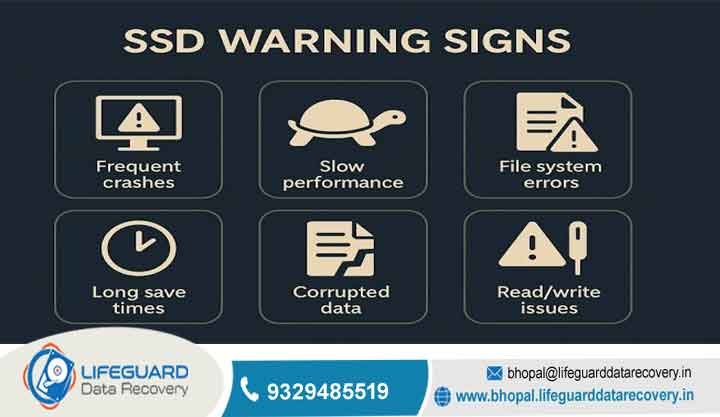
The trickiest thing about a failing solid-state drive is that it degrades completely silently without making any clicking or grinding sounds like an old mechanical drive. The early warning signs usually pop up as random system crashes when you are trying to boot up,
When Customers Should Contact Us Immediately
You need to bypass temporary software fixes and get in touch with a specialized data recovery laboratory the exact moment your drive shows clear signs of a serious hardware breakdown. If your drive stops detecting in the system BIOS, if your computer completely freezes up whenever you try to open a specific file path, or if a drive constantly drops offline during heavy work sessions, you are dealing with a critical failure.
Trying to fix these intense hardware problems using basic store-bought recovery software or generic computer repair shops will almost always lead to irreversible metadata damage and permanent block overwrites.
Turn the system off right away and let professional cleanroom engineers handle the media.
Secure Your Business Assets: Contact Lifeguard Data Recovery UAE
If your business is currently facing a data loss emergency or if a primary server array has just crashed, do not wait and risk losing your files forever. Get in touch with the engineering team at Lifeguard Data Recovery right now to secure your company’s digital assets.
We provide transparent diagnostics, a ironclad no data no charge guarantee, and completely secure, confidential processing for every single drive that enters our lab facility.
-
Call: +971 50 127 6793
-
Email: info@lifeguarddatarecovery.com
-
Visit Our Main Laboratory: Electra Street, 11 Al Raqqay Street, Al Danah, E10, Abu Dhabi, United Arab Emirates (With full corporate courier and drop-off logistics running daily across Dubai, Sharjah, and all Northern Emirates)