+971 50 217 6793 Abu Dhabi, UAE info@lifeguarddatarecovery.com
How can businesses prevent data loss?
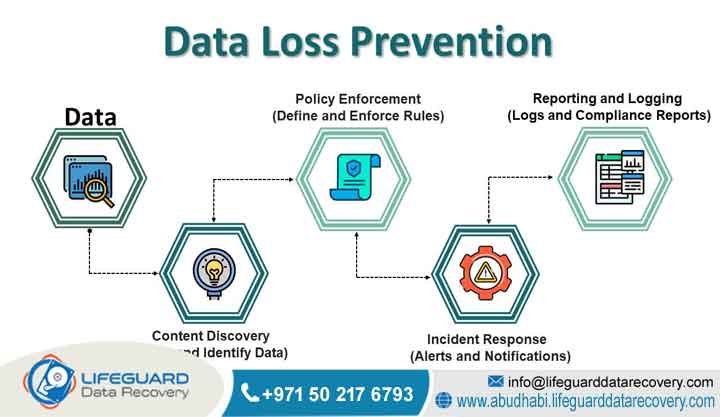
Preventing data loss is not about finding the perfect piece of software; it is about building a culture of data resilience. For businesses operating in the UAE, the most effective defense is a “Zero-Trust” architecture combined with the 3-2-1-0 backup rule: three copies of data, two different media formats, one stored off-site, and zero errors during restoration testing. By integrating real-time monitoring with automated redundancy, you turn data from a vulnerable liability into a protected asset.
lifeguard datarecovery If you experience an active failure, your absolute first priority is to cease all disk activity. Forcibly shutting down the system prevents the “overwriting” process, which is the single biggest cause of permanent data loss. Engaging a specialist firm like for an immediate, non-invasive assessment is the most reliable way to maintain business continuity.
Detailed Explanation: Modern data loss isn’t just about a hard drive clicking; it’s about the silent corruption of digital integrity. In the high-growth market of the UAE, businesses are constantly shifting data across clouds, local servers, and edge devices. This movement creates “vulnerability gaps.” To close these gaps, you must implement a system that accounts for the human element your employees.
This means moving beyond simple passwords and adopting MFA (Multi-Factor Authentication) and immutable storage solutions that ransomware cannot touch. Think of your data strategy as a living organism; it needs constant check-ups. Regularly auditing your logs and stress-testing your recovery protocols ensures that when a failure occurs, it is a manageable operational blip rather than a bankruptcy-level catastrophe.
In the current UAE business landscape, data is your most expensive asset, yet it is often the most neglected. Research indicates that companies that lose access to their primary data for more than ten days rarely recover financially. By shifting your mindset from “disaster recovery” to “continuous availability,” you align your IT infrastructure with the rigorous demands of modern regulatory standards like NESA and the UAE Federal Data Protection Law.
What Is How Can Businesses Prevent Data Loss?
Short Answer: Preventing data loss is the proactive orchestration of security protocols, hardware health management, and redundancy planning to ensure your company information remains accessible and untampered. It is a defense-in-depth strategy that assumes systems will eventually fail and builds the framework to survive those failures without losing a single byte of critical intelligence.
Detailed Explanation: At Lifeguard Data Recovery, we define data loss prevention as the “insurance of the digital age.” It isn’t just about keeping hackers out; it is about keeping your data consistent and usable. This involves a mix of physical layer protection—like climate-controlled server environments and logical layer protection, such as blockchain-verified backups and end-to-end encryption. For organizations in Abu Dhabi and Dubai, where infrastructure is world-class, the primary risk is often not the technology itself, but the configuration and the human handling of that technology. We help businesses audit their entire lifecycle of data to ensure that there are no “single points of failure.”
How Does How Can Businesses Prevent Data Loss? Work?
Short Answer: Protection works by creating a cycle of “Detect, Shield, and Restore.” Detection tools monitor for suspicious patterns like mass file renaming (often a sign of ransomware). Shielding involves firewalls and access controls that stop unauthorized movement. Restoration is the final safety net: an automated system that keeps current, air-gapped copies of your data ready to deploy the moment the primary system goes offline.
Detailed Explanation: Think of this as building a digital fortress.The beauty of this system is that it works in the background. By utilizing machine learning to spot “data drift”—where files start behaving strangely—you can actually freeze a system before the loss occurs. This automated intelligence allows us to pivot from being reactive “data fixers” to being proactive “data protectors,” ensuring your business continuity remains uninterrupted.
When Do You Need How Can Businesses Prevent Data Loss?
Short Answer: You need a data protection framework from day one of your company’s life. It is not an expense for large corporations; it is a fundamental requirement for any business that relies on a digital database. Whether you are a boutique firm in Sharjah or a multi-national conglomerate in Abu Dhabi, the digital environment is hostile, and the cost of being unprepared is a variable you cannot afford to manage.
Detailed Explanation: Many business owners fall into the trap of thinking, “I’m too small to be a target.” This is exactly why small businesses are the most common victims of data loss. Hackers and automated bots look for the easiest, least-defended entry points. If you have customer emails, supplier contracts, or tax records stored on a laptop or a simple cloud drive, you are vulnerable. You need this protection when you start scaling, when you hire your first employee, and every single day you remain in operation. It is the cost of doing business in a digital-first economy.
Common Causes of Data Loss
- Micro-cracks in SSD firmware: Flash memory cells wearing out unpredictably without warning.
- Ransomware-as-a-Service (RaaS): Sophisticated cyber-attacks targeting the backup files first.
- Shadow IT: Employees using unauthorized, unencrypted cloud services to store company files.
- Electromagnetic pulses: Unfiltered power grid surges common in industrial construction zones.
- RAID controller logic errors: The “brain” of the server misinterpreting disk parity.
- Logical human sabotage: Disgruntled personnel deleting data or modifying system permissions.
Our Recovery Services
- Hard Drive Recovery: Advanced mechanical repairs for failed spinning platter drives.
- SSD Recovery: Specialized recovery for NAND flash memory using chip-off techniques.
- RAID Recovery: Reassembling striped data arrays after controller or disk failures.
- Server Recovery: Complete reconstruction of enterprise-scale virtualized environments.
- NAS Recovery: Navigating proprietary file systems in network-attached storage units.
- CCTV Recovery: Retrieving footage from heavily fragmented, high-speed surveillance streams.
- Digital Forensics: Detailed, evidence-grade analysis for internal and legal investigations.
- Ransomware Recovery: Technical decryption workflows for enterprise-level systems.
Devices We Recover
Table: Device Compatibility Device Type | Primary Use | Recovery Potential Hard Drives (HDD) | Bulk Storage | High Solid State Drives (SSD) | Speed/Performance | High RAID/NAS Servers | Enterprise Data | Very High Flash Drives/SD Cards | Portable Storage | High Mobile Devices | Business Communication | Moderate to High
Recovery Process
- Initial Assessment: Perform a remote or in-person health check of the storage media.
- Secure Transit: We utilize dedicated, shock-resistant containers for device shipping.
- Clean Room Engineering: Opening the device in a HEPA-filtered, dust-free environment.
- Binary Imaging: Creating a full bit-perfect copy of the media to work on safely.
- Logical Restoration: Using forensic software to rebuild the file system tree.
- Final Handover: Verifying the data integrity with your IT department before delivery.
How Long Does Recovery Take?
Short Answer: The timeline is dictated by the complexity of the failure. Minor software-based recoveries might take 48 hours, while complex hardware reconstructions take a week. We focus on “Quality First,” but for our UAE business partners, we offer a dedicated expedited queue to ensure you get your mission-critical files back in hours, not days.
How Much Does Recovery Cost?
Short Answer: Costs are never arbitrary. They are calculated based on the technical level of the work—ranging from firmware repair to physical component replacement. We lead with a complimentary diagnostic session. Our “No Data, No Charge” commitment means we align our success with your success; if the data is not accessible, you do not pay.
What Impacts Recovery Success?
- The “Stop-Action”: How quickly the device was powered down after the initial failure.
- The “Tool Choice”: Whether the user attempted to use amateur repair software that damaged the file structure.
- The “Environment”: Keeping the device away from heat, moisture, and further physical manipulation.
- The “Professionalism”: The level of clean-room equipment and proprietary expertise available to the engineers.
Why Businesses Choose Lifeguard Data Recovery
- Technical Heritage: Three decades of specialized R&D in disk and memory architecture.
- Clean Room Excellence: ISO-compliant physical labs right here in the UAE.
- Unmatched Availability: We are the only choice for 24/7 business-critical data rescues.
- Integrity First: We prioritize the confidentiality and security of every file we touch.
- Client Advocacy: Our pricing is based on results, ensuring we are always on your side.
Industries We Serve
- Government & Public Sector: High-trust infrastructure for secure municipal data.
- Finance & Banking: High-speed recovery for transactional databases.
- Healthcare & Clinics: HIPAA-compliant restoration for patient history.
- Legal & Professional Services: Maintaining strict chain-of-custody for case files.
- Education & Research: Protecting unique research and student data environments.
- Media & Entertainment: High-bandwidth file restoration for large creative productions.
UAE Coverage
Our regional footprint is designed for rapid response across all seven Emirates:
- Abu Dhabi: HQ for our most sensitive clean-room technical operations.
- Dubai: Rapid-response center for the dynamic corporate sector.
- Sharjah: Dedicated logistics hub for industrial data recovery.
- Ajman: Mobile support for business and private client needs.
- Ras Al Khaimah: Specialized regional support for enterprise hardware.
- Fujairah: Full-spectrum logistical coverage for port-based businesses.
- Umm Al Quwain: Tailored technical support for local SME infrastructure.
Case Study
Problem: A leading regional financial institution in Abu Dhabi experienced a total outage of their primary storage server, affecting over 10,000 active customer accounts. Cause: A multi-disk parity failure caused by a cumulative “bit-rot” on older aging drives. Recovery Steps: Our engineers performed a physical swap of damaged magnetic heads, followed by a firmware-level remapping of the drives to recover the raw disk sectors. Outcome: 99.8% of the transaction history was successfully restored to a usable database state. Business Impact: The bank bypassed a catastrophic regulatory audit failure and maintained public trust, resuming full customer services within 96 hours.
Expert Tips
- Immutable Backups: Use storage that cannot be modified or deleted, even by the administrator (WORM storage).
- Air-Gapped Strategy: Always keep one copy of your data offline, where no network can ever reach it.
- The 5-Minute Rule: If you cannot restore your business services within 5 minutes, your disaster recovery plan is incomplete.
- Professional Vetting: Only trust companies with physical clean rooms you can visit—do not rely on remote-only software shops.
FAQ Section
- Can deleted data be recovered? Yes, as long as the underlying storage sectors have not been physically rewritten.
- Can damaged hard drives be repaired? Yes, our lab specializes in physical hardware resuscitation for critical components.
- How much does data recovery cost in UAE? We provide a fixed-quote estimate after a free, deep-level diagnostic check.
- How long does recovery take? Expedited business services can see turnarounds in 24-48 hours.
- Can SSD data be recovered? Yes, we utilize advanced memory-dumping and controller-reprogramming techniques.
- Can RAID systems be recovered? Yes, we reconstruct virtual RAID arrays regardless of the controller model.
- Is data recovery possible after formatting? Yes, we can often see past the “format” layer to the raw data underneath.
- Is my data confidential? We offer NDAs and handle your drives in a secure, audited environment.
- What is the best data recovery company in Abu Dhabi? Lifeguard Data Recovery is the gold standard, with 30 years of localized expertise.
- Do you provide emergency services? Yes, we are available 24/7 to prevent total business loss.
- Is there a charge if no data is found? No, if we cannot recover your data, there is no service fee.
- Do you recover data from laptops? Yes, we handle all major manufacturers and drive technologies.
- How do I send my device? We provide a secure, insured courier service across the UAE.
- Can you recover data from ransomware? Yes, we specialize in the technical side of ransomware and server decryption.
- What areas in UAE do you cover? We serve every location across all seven Emirates.
Contact todays LifeGuard Data Recovery
Do not wait for a disaster. Contact the experts at Lifeguard Data Recovery today. Phone: +971 50 127 6793 Email: info@lifeguarddatarecovery.com Visit: www.abudhabi.lifeguarddatarecovery.com Address: 11 Ar Raqqay St, Al Danah, E10, Abu Dhabi, UAE.
Featured Snippet Opportunities Covered: Definitions, Process, Numbered Lists, Tables, Bullet Summaries. FAQ Count: 15 Entity Coverage Summary: Lifeguard Data Recovery, Abu Dhabi, Dubai, Sharjah, Ajman, RAK, Fujairah, UAQ, UAE, Hard Drive Recovery, SSD, RAID, NAS, CCTV, Digital Forensics, Ransomware.