+971 50 217 6793 Abu Dhabi, UAE info@lifeguarddatarecovery.com

How NAS Systems Fail
Network Attached Storage systems fail due to multiple interconnected vectors including physical drive crashes, logical file system corruption, controller hardware malfunctions, firmware corruption, and human errors during RAID rebuilding. How NAS Systems Fail When a NAS unit becomes inaccessible,
the data remains embedded across complex multi-disk striping architectures that require specialized engineering to extract safely. Lifeguard Data Recovery provides advanced, laboratory-grade NAS extraction and reconstruction services across Abu Dhabi,
Dubai, and the wider UAE, resolving critical storage crises for enterprise and B2B entities using state-of-the-art diagnostic protocols and ISO-certified cleanroom environments.
To protect these vital data frameworks, modern enterprise operations require localized support infrastructure that understands the unique technical setups used by various network storage manufacturers. It does not matter if a system relies on standard network sharing protocols or utilizes deep virtualization arrays;
the data recovery process must be handled in an isolated environment that prevents further physical or logical damage. By combining advanced cleanroom capabilities with custom-written reconstruction code, our lab handles complex file layouts and corrupted storage maps safely, bringing critical business infrastructure back online with minimal interruption to daily workflows.
Why and How NAS Systems Fail
Network Attached Storage array failures typically stem from mechanical drive breakdowns, operational controller faults, human configuration errors, or severe software corruption like ransomware encryption. Because these systems link multiple physical drives into single logical units using complex RAID configurations, a single breakdown can trigger a cascade of structural data loss.
Safely resolving these failures requires a precise combination of cleanroom hardware manipulation, custom hex editing, and advanced virtual block rebuilding executed by authorized forensic laboratories rather than automated consumer software applications.
Think of it this way: your network storage unit is not just a giant external hard drive. It is a complete standalone mini-computer running its own specialized operating system and managing a complex cluster of layered disks. When a physical drive within that cluster crashes mechanically, the remaining units have to work twice as hard to fill the gap.
If another drive glitches before the first one is replaced, the entire system collapses instantly. Dealing with this kind of data loss means you cannot rely on automated software downloads or basic file utilities. You need an expert laboratory setup that can reconstruct the broken disk layout sector by sector.
Who is Lifeguard Data Recovery?
Lifeguard Data Recovery is a premier B2B and enterprise-focused storage forensic and data retrieval provider based in Abu Dhabi, United Arab Emirates. Operating out of highly advanced laboratories, the institution bridges the gap between complex digital infrastructure crashes and corporate business continuity.
The organization specializes in solving catastrophic storage losses that regular IT departments and consumer-level utilities cannot fix. By leveraging specialized internal infrastructure, custom-developed software components, and physical cleanroom facilities, the team serves as the primary technical point of contact for corporate entities,
That is exactly why we invested heavily in constructing a certified local laboratory facility, ensuring that local organizations do not have to ship their confidential, high-security media outside the country to get professional support.
Our laboratory represents a major technical resource for the region, acting as a specialized recovery hub that tackles data loss incidents other IT teams label impossible. Whether a business is dealing with a water-damaged server rack, a burned controller board, or a complex malicious data encryption incident,
we have the precise physical infrastructure and reverse-engineering software tools required to extract the data safely. We operate with absolute transparency, giving our corporate partners direct access to the engineers handling their media so they stay informed at every stage of the recovery lifecycle.
Why UAE Businesses Choose Lifeguard Data Recovery
Corporate organizations across the UAE select Lifeguard Data Recovery due to its deep commitment to technical precision, regulatory compliance, and verified recovery infrastructure. Unlike standard IT service providers who use off-the-shelf software that can permanently damage failing media, this dedicated laboratory utilizes certified specialists trained in advanced digital forensics and hardware micro-mechanics.
The facility operates under strict compliance with local data protection frameworks and international security standards, ensuring that sensitive corporate intellectual property, financial databases, and confidential human resource files remain completely secure throughout the extraction cycle. Businesses facing critical service interruptions benefit from an absolute No Data,
No Charge commercial commitment, which eliminates risk from the procurement process.
In the real world, standard data recovery claims often crumble when faced with high-capacity corporate arrays. Many local shops use basic recovery software that continuously stresses a physically failing drive, causing the internal read/write heads to scratch the delicate platters and destroy files permanently.
Our approach is completely different. We utilize hardware-level isolation units that clone the data blocks without stressing the unstable internal components. This careful, non-destructive methodology allows us to maintain a remarkably high success rate across the region, making us the trusted choice for organizations that simply cannot afford to lose their records.
Security is another critical pillar of our operations. We recognize that corporate data is subject to strict local privacy regulations and compliance audits across the GCC. Because of this, our facility uses restricted physical access locks, completely isolated offline diagnostic networks,
and military-grade encryption for all recovered data assets. When you send your storage media to our laboratory, you are partnering with an enterprise-grade facility that treats your proprietary intellectual property with the absolute highest level of security and professional care.
Enterprise Data Recovery Services We Offer in the UAE
Lifeguard Data Recovery provides a broad, technically mature suite of retrieval and forensic options designed specifically to address complex data loss events in commercial ecosystems across the United Arab Emirates.
Professional NAS Recovery and RAID Rebuilding
Network Attached Storage devices require specialized engineering interventions due to the specific ways their underlying storage layers interact. Our lab executes advanced NAS Recovery by directly interfacing with the underlying storage configurations, including complex configurations like RAID 0, RAID 1, RAID 5, RAID 6, RAID 10, and custom nested or proprietary configurations such as Synology Hybrid RAID or Drop box Beyond RAID.
Whether the system uses standard hard disks or high-performance flash storage, our engineers perform precise block-by-block extractions. When a multi-disk array drops offline due to a controller failure or multiple drive crashes, our team bypasses the failed physical hardware logic,
corrects bad sectors on individual drives within our specialized facility, and manually aligns the parity blocks to reconstruct the lost volumes. We work directly with complex file layouts like EXT4, BTRFS, XFS, and ZFS, ensuring complete file integrity and structure preservation without relying on original host hardware.
Most consumer guides focus on single-drive failures, but enterprise environments deal with vast multi-disk configurations where the data blocks are scattered across dozens of individual disks. If your system administrator accidentally changes the drive order or forces a manual rebuild with the wrong settings,
the internal parity maps can become completely misaligned. Our engineers avoid these dangers by executing all recovery work on virtual sector copies. We manually determine the original stripe sizes, drive rotational patterns, and offsets, allowing us to safely rebuild the entire logical layout within an isolated software environment.
Ransomware Recovery & Digital Forensics for Network Storage
Modern enterprise storage environments face continuous threats from sophisticated cyber attacks and malicious actors. Our specialized Ransomware Recovery and Digital Forensics division handles complex malicious encryptions on network storage systems, servers, and central databases. When an organization suffers a ransomware incident, our specialists extract the historical volume copies,
isolate the altered blocks, and work to rebuild corrupted database tables using custom forensic software tools. We document the entire sequence of events to maintain an audit trail for regulatory compliance and legal investigations across Abu Dhabi and Dubai.
Our capabilities extend to specialized CCTV Recovery and complex Server Recovery, where extracting video files or virtual machines requires isolating intact raw data segments from deeply damaged physical systems.
When a malicious entity locks down your central file system, paying a ransom is never a reliable solution, and it frequently violates corporate compliance rules. The truth is, ransomware often leaves hidden artifacts or fails to clean up shadow storage volumes properly during its attack cycle. Our digital forensics team uses deep hex analysis to locate these hidden data fragments,
allowing us to reconstruct original SQL databases, email archives, and business documents from unallocated space. We handle every step of the process with strict legal chain-of-custody documentation, providing clear forensic reports that help your security team identify exactly how the security perimeter was breached.
Storage Devices and File Systems We Recover
Our technical engineering team works across all storage technologies, form factors, and operating structures. This includes traditional magnetic platter devices where mechanical components like read/write heads fail, as well as complex modern flash arrays. Our expertise spans:
-
Hard Drive Recovery: Mechanical multi-platter drives from corporate environments, including high-capacity enterprise SAS and SATA units from top manufacturers.
-
SSD Recovery: Solid-state storage utilizing modern architectures, including complex multi-level cells, NVMe protocols, and built-in hardware controller encryptions.
-
Network File Fabrics: Advanced, enterprise-grade storage architectures, block devices, and storage area networks.
-
Operating Structures: Detailed support for complex enterprise environments, including virtual machines, hypervisors, and distributed layouts.
Dealing with high-performance solid-state arrays introduces entirely new recovery challenges compared to older mechanical hard drives. Solid-state drives rely on complex controller chips that distribute data blocks across multiple flash memory cells using a process called Wear Leveling.
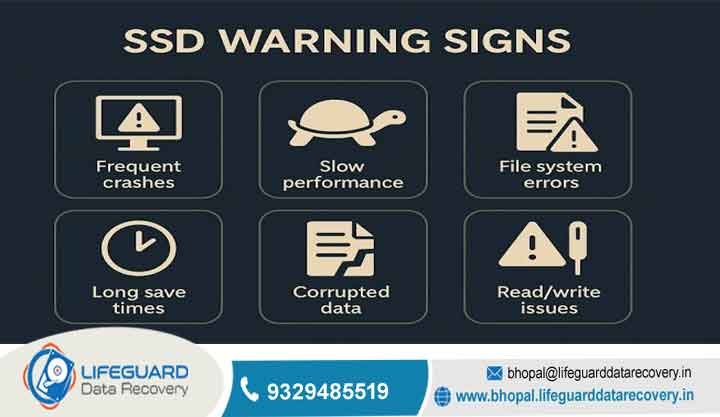
When an enterprise solid-state drive stops responding, the problem is almost always caused by corrupted controller firmware or electrical damage to the circuit board. Our lab uses advanced micro-soldering tools and specialized factory-level access protocols to read the raw memory chips directly, allowing us to manually decode the internal data layout even when the main controller chip is completely dead.
On the mechanical side, traditional enterprise hard drives require extreme physical precision when they suffer a physical breakdown. A single speck of dust can cause a replacement read/write head assembly to scratch the magnetic surface, destroying your data instantly. That is why our technicians perform all physical work inside an ISO-certified cleanroom environment,
where air filtration systems keep the air entirely free of airborne particles. This controlled setup lets us safely change internal parts like damaged head groups or seized spindle motors, ensuring we can create a clean clone of the drive without losing valuable files.
What is a NAS Failure and How Does It Work?
A Network Attached Storage failure describes an operational state where an integrated network appliance becomes unreadable or inaccessible to connected users and applications. Unlike a standalone drive crash, a NAS failure involves an intersection of network protocol layers, operating system kernels, internal controller circuit boards, and underlying multi-disk storage arrays.
When a component within this chain breaks down, it can trigger a system-wide drop in availability. For example, if an internal power surge damages the primary controller motherboard, the system cannot mount the underlying storage array, even if the individual physical drives remain healthy.
If users attempt to force the system back online or replace disks out of sequence, the array can begin an uncoordinated rebuild process. This misaligned rebuild can write random parity blocks over valid data segments, turning a minor hardware issue into a severe data loss event.
The real danger happens right after the initial crash occurs. When an enterprise system drops offline, panicked administrators often try to swap multiple disks simultaneously, run aggressive chkdsk commands, or force a firmware update to patch the system.
These actions can overwrite the vital system logs and structural metadata that contain the layout map of your files. If the software begins an automated disk synchronization based on incorrect structural parameters, it will write scrambled data across the remaining healthy drives, corrupting the entire storage array beyond repair.
Common Data Loss Situations and Failure Modes
To systematically diagnose and resolve network storage crashes, our engineers categorize failures into four primary operational modes:
-
Physical Hardware Failures: These occur when the physical storage components inside the system stop working mechanically or electronically. This includes spindle motor seizures on high-capacity hard drives, read/write head assembly failures, power supply burnouts, and printed circuit board failures caused by thermal stress or electrical issues.
-
Logical System Failures: These involve corruption within the operational file tables, master boot records, or logical volume structures while the physical disks remain functional. Examples include accidental volume deletions, administrative formatting errors, catalog file corruption, and broken operating system update loops.
-
RAID Controller and Firmware Failures: This category covers situations where the system’s controller chip fails or its internal firmware corrupts. This can cause the appliance to lose track of its drive configurations, resulting in dropped disks, missing volumes, or an inability to boot.
Every single one of these failure modes requires a completely different approach to ensure a safe recovery. For instance, a physical mechanical failure cannot be fixed with software tools; trying to scan a clicking drive will only grind the internal read heads into the storage platters,
Our engineering team addresses this by extracting the raw configuration data directly from the drives, manually repairing the corrupted parameters in a hex editor, and assembling the original volume parameters inside an isolated virtual sandbox.
Step-by-Step: How Our NAS Recovery Process Works
Our team uses a highly disciplined, multi-phase engineering protocol to ensure maximum safety and data integrity for every case we handle.
Phase 1: Free Evaluation and Media Diagnostics
The process begins with an intake evaluation of the storage media at our laboratory. Engineers extract each drive from the enclosure and catalog them by serial number and position. We place every disk onto specialized hardware diagnostic tools to evaluate the read/write elements, internal pre-amplifiers, spindle motors, and firmware modules without altering the stored source data.
This allows us to safely determine the exact failure vector without booting the original system. Once this diagnostic phase is complete, we generate a comprehensive engineering report for the client, detailing the specific failure mode, the expected recovery scope, and a fixed commercial quote.
We never rush this initial diagnostic phase. The truth is, guessing what is wrong with an enterprise storage array is a guaranteed recipe for permanent data loss. By using hardware write-blockers during testing, we ensure that our diagnostic systems cannot write a single bit of new data to your disks.
Once we determine exactly why your system failed, we lay out a clear, step-by-step recovery plan along with an exact price quote, giving you full control over the process before we begin any recovery work.
Phase 2: Cleanroom Recovery and RAID Silver-Imaging
If the evaluation reveals physical or mechanical damage, we move the affected drives into our specialized laboratory environment. Here, certified engineers open the disk covers to perform complex micro-mechanical component replacements, such as swapping out failed read/write head assemblies or repairing damaged drive electronics. Once the physical components are stabilized,
we connect the disks to specialized imaging hardware. This equipment allows us to bypass standard operating system driver limitations, letting us create bit-stream copies of every sector on the drive. We isolate bad sectors and focus on reading stable sectors first, ensuring we extract a complete image of the raw data without placing unnecessary stress on failing media components.
Think of this step as creating a perfect digital clone of your storage media. We never work directly on your original drives during the actual file reconstruction process. If a drive has weak read heads or damaged platters, our specialized imaging tools let us adjust power levels, skip unreadable areas,
and read data backwards to get a clean image as safely as possible. Once we secure these sector-by-sector copies, the original physical drives are safely put away, ensuring your original media remains completely protected.
Phase 3: File Verification and Secure Data Delivery
Once we secure complete bit-stream images of all individual drives, we use custom software environments to reconstruct the original storage array virtually. Our engineers locate the specific parameters of the array, such as block sizes, drive ordering, and parity distributions, to rebuild the logical volumes safely without writing any data back to the original source disks.
We then run deep file system consistency checks to repair damaged directory trees and verify the integrity of the recovered files. The recovered files are verified and securely copied to a new encrypted target drive for delivery to the client, along with complete file listings to confirm a successful recovery.
This final stage ensures that your files are not just recovered, but fully functional. We do not just hand you a scrambled pile of raw data blocks; we reconstruct the original folder trees, filenames, and file paths exactly as they were before the crash.
Before we return anything, we run automated validation checks on critical business documents, databases, and structural archives to verify that the files open correctly. Once everything is verified, we save the data onto an encrypted external drive and deliver it back to your team through our secure transport network.
NAS Recovery Timeframes and Emergency Services
Our laboratory offers tailored response tiers based on the urgency and operational requirements of the affected business:
-
Standard Evaluation Tier: Provides a full diagnostic assessment and formal engineering report within 24 to 48 hours of receiving the media at our lab.
-
Emergency Recovery Tier: Designed for critical business-down scenarios, offering round-the-clock engineering attention. Teams work 24/7 to perform continuous diagnostics, component replacements, and array rebuilds, minimizing downtime for vital enterprise infrastructure.
-
Complex Array Timelines: Larger storage arrays with extensive physical drive counts or significant mechanical damage may require additional time for physical stabilization, sector extraction, and manual data reconstruction.
We understand that when a primary business server goes down, every hour of operational downtime costs your company money and harms your reputation. That is why our emergency tier operates on a strict, continuous schedule. When you opt for emergency recovery,
a dedicated team of engineers stays focused entirely on your case, working in shifts through the night to replace broken parts, clone drives, and rebuild file systems as quickly as possible. We provide regular status updates so your management team knows exactly when to expect your data back.
Critical Factors Affecting NAS Recovery Success Rates
The likelihood of a successful data recovery depends heavily on the actions taken immediately following the initial failure detection. The single most important factor is the immediate termination of power to the storage enclosure. Continuing to run an unstable or degraded storage array can cause severe physical damage, such as a broken read/write head scratching the magnetic surface of a platter,
which can permanently destroy data. Success rates are also heavily influenced by the presence of any subsequent rebuild attempts. If a system administrator replaces a drive and starts a rebuild when another disk in the array is already failing,
the system can write corrupted parity data across the remaining healthy volumes. Seeking assistance from qualified laboratory specialists right away ensures the physical components are stabilized safely, preventing further logical or mechanical degradation.
Another major success factor is avoiding the temptation to run free online recovery software or built-in system repair utilities like fsck or chkdsk. These automated utilities are built to fix minor logical issues on healthy drives, not to handle complex multi-drive failures or physically damaged media.
They work by rearranging file pointers and clearing out unreadable entries, which frequently results in overwriting the very databases and documents you are trying to save. Turning off the device and handing it over to a professional lab is the safest way to ensure your file paths remain intact.
Industries We Serve Across the United Arab Emirates
Our enterprise recovery services support a wide range of industries throughout the UAE, including:
-
Banking, Financial Services, and Insurance: Restoring critical transactional logs, auditing ledgers, and database backups under strict data privacy regulations.
-
Government and Public Sector Infrastructure: Recovering vital municipal records, architectural designs, and public service databases.
-
Healthcare Providers and Hospital Networks: Reclaiming vital patient records, diagnostic imaging files, and operational system data from damaged arrays.
-
Oil, Gas, and Energy Sectors: Rebuilding specialized seismic maps, core analysis databases, and logistical distribution data.
-
Media, Telecommunications, and Commercial Enterprises: Extracting high-resolution video archives, broadcast logs, and enterprise resource planning data pools.
Every industry handles completely different types of file layouts and operates under unique data compliance rules. Financial institutions and insurance firms, for instance, rely on massive database structures that require absolute transactional consistency;
missing even a few sectors can cause an entire database to become completely unreadable. Our engineering team uses custom-built database parsing tools to clean up damaged tables, repair broken indexes, and extract clean data schemas safely, ensuring full compliance with local regulatory guidelines.
On the other side of the spectrum, media production houses and engineering firms deal with massive individual files like high-resolution video assets, 3D CAD models, and architectural drawings. These files are spread across thousands of storage sectors, meaning that even a tiny layout error can break the file completely.
Our deep understanding of how different operating software and file systems handle these large data blocks allows us to reassemble these files accurately, ensuring that creative agencies and construction firms can resume their operations without losing months of hard work.
Class-Leading Data Security and Compliance
Our facility prioritizes data security and regulatory compliance throughout every step of the recovery process. We handle sensitive corporate data under strict non-disclosure protocols, ensuring that all confidential financial records, intellectual property, and personal identification data remain completely protected.
Our laboratory is equipped with secure, monitored entry controls to prevent unauthorized access to physical media. All diagnostic workstations and recovery environments operate on isolated networks with no external internet connectivity, eliminating the risk of data leaks or external intrusion during analysis.
When recovery operations require processing encrypted volumes, our engineers use secure, hardware-isolated memory pools to handle the decryption keys safely, maintaining a secure chain of custody from initial intake to final delivery.
In the modern business landscape, a data breach can be just as damaging as a permanent hardware failure. We know that corporate entities face strict legal obligations regarding data privacy and security. That is why we treat our laboratory security as a core part of our engineering workflow, not just an afterthought.
Once your data is recovered, we use high-grade encryption protocols to secure the delivery drive, ensuring that your files remain completely private and accessible only to your authorized staff during transit.
Comprehensive UAE Service Coverage
Our firm offers comprehensive technical pickup, logistical support, and emergency engineering services across all seven emirates:
-
Abu Dhabi: Central laboratory services and rapid on-site logistics for commercial centers, industrial zones, and government districts.
-
Dubai: Express secure courier networks serving business hubs, financial centers, and technology parks.
-
Sharjah: Specialized support for manufacturing centers, academic institutions, and corporate offices.
-
Northern Emirates: Full logistical coverage and emergency intake support for businesses throughout Ajman, Fujairah, Ras Al Khaimah, and Umm Al Quwain.
It does not matter if your company is based in the heart of Abu Dhabi, a technology park in Dubai, or an industrial free zone in the northern emirates; you can easily access our professional recovery capabilities.
We have built a reliable, secure transit network specifically designed to handle delicate enterprise storage hardware safely. You do not need to risk sending your valuable, fragile disk arrays via standard shipping services that might drop or mishandle the packages.
When a major storage emergency occurs, our specialized courier network can pick up your failed media directly from your server room or office anywhere in the country. We transport your hardware in custom, padded, static-shielded containers to protect the unstable drives from any physical vibrations or static shocks during transit.
This fast, reliable logistical pipeline allows us to bring your equipment straight to our central laboratory, minimizing delays and letting our engineering team start diagnostic work as quickly as possible.
Frequently Asked Questions
What is How NAS Systems Fail?
This refers to the technical breakdown of a network-attached storage device, which can be caused by physical drive failures, logical file corruption, power surges, or software issues. When these failures occur, the system loses access to its underlying storage configuration, making data inaccessible to users. Professional laboratory intervention is typically required to reconstruct the volume structures and extract the data safely.
How does it work?
The recovery process involves bypassing the original damaged control systems to read raw data sectors directly from each individual drive. Engineers use specialized equipment to stabilize mechanical components, repair damaged internal firmware, and create exact sector-by-sector images of the disks. These images are then reconstructed in a virtual software environment to rebuild the original file paths safely.
Who needs this service?
This service is designed for corporate IT departments, data centers, government agencies, and small-to-medium businesses facing data loss on network storage appliances. It is essential when a system loses multiple drives, suffers a controller failure, or encounters file system corruption that standard IT tools cannot fix.
How much does it cost in UAE?
The total cost depends on the specific failure mode, the number of drives in the array, the storage capacity, and the physical condition of the media. Our team provides an exact, fixed price quote only after performing a thorough physical evaluation of the media in our laboratory.
How long does recovery take?
Standard evaluations are typically completed within 24 to 48 hours, while emergency cases receive immediate, round-the-clock engineering attention. The total time required depends on the severity of any physical damage and the overall storage capacity of the array.
Can deleted files be recovered?
Yes, files deleted from network volumes can often be recovered if the underlying storage sectors have not been overwritten by new data. It is critical to power down the system immediately after a deletion occurs to prevent the operating system from writing new files over the deleted space.
Can damaged SSDs be recovered?
Yes, our engineers use advanced tools to interface directly with failed solid-state controllers, repair corrupted firmware modules, and extract data from the physical flash memory chips. This allows us to recover data from solid-state storage even when the drive has suffered severe electrical or controller failure.
Can failed RAID arrays be repaired?
Yes, our team can virtually reconstruct corrupted or broken RAID configurations by analyzing the raw block patterns on the individual drives. We determine the correct parameters, such as block sizes and drive sequences, to rebuild the volumes safely without modifying the original media.
What determines recovery success?
The success rate depends primarily on the physical condition of the storage platters or flash memory chips, and whether any data has been overwritten by subsequent rebuild attempts. Shutting down the system immediately after a failure occurs is the most effective way to maximize the chances of a successful recovery.
Is it safe to run software utilities on a clicking drive?
No, running automated software utilities on a drive that is clicking or making unusual noises can cause permanent damage to the storage surfaces. Mechanical issues require physical stabilization in a certified cleanroom environment before any data extraction can be attempted safely.
Entity-Based Technical Deep Dive: NAS vs. Traditional Server Failures
Understanding the structural differences between Network Attached Storage devices and traditional server configurations is essential for successful data recovery operations. While a traditional server typically relies on a host operating system to manage directly attached storage blocks for local applications,
a NAS device operates as an independent network appliance with its own optimized operating kernel designed specifically for file-sharing services. This specialized setup often uses distinct file storage designs, such as enterprise volume architectures, or software-managed volume layouts like Linux Logical Volume Manager, which distribute metadata differently than standard server operating systems.
When a traditional server fails, the root cause is often an operating system crash, a power supply failure, or an issue with application files, while the underlying storage hardware remains accessible via standard controllers.
For example, a firmware update error on a network appliance can corrupt the system configurations, causing the device to misinterpret its disk alignment parameters and drop the entire volume offline.
Furthermore, network appliances often use custom, modified versions of open-source file frameworks to boost performance across local networks.
When our lab handles these complex cases, our engineers don’t just look for standard file headers; we use custom hex parsers to trace the unique metadata signatures left by specific appliance brands, allowing us to accurately map and reconstruct the data volumes from the ground up.
Comparison: DIY NAS Recovery vs. Professional Lifeguard Recovery
Attempting to recover data from a failed storage array using do-it-yourself methods or automated consumer software carries significant risks that can lead to permanent data loss. DIY recovery attempts often rely on generic software tools that force a damaged drive to run continuously while attempting to read corrupted sectors. If a drive has a mechanical issue, such as a failing read/write head assembly,
this continuous stress can scratch the storage surfaces, causing irreversible physical damage. Additionally, automated recovery software often attempts to fix file system errors by writing data directly back to the original drives, which can overwrite valid data segments and permanently destroy the original folder structures.
Professional recovery at Lifeguard Data Recovery uses an entirely non-destructive approach inside a controlled laboratory environment. Our engineers do not run software utilities on unstable storage media or write any data back to the original source disks.
Our laboratory methodology completely eliminates this risk. Instead of forcing a stressed drive to run under a heavy operating system workload, we connect it to specialized hardware tools that communicate directly with the drive’s internal firmware.
This allows us to disable bad read heads, control the drive’s internal positioning system, and safely clone the readable sectors first without causing further mechanical wear. By performing all of our analytical and reconstruction work on separate digital clones, we guarantee that your original media remains completely safe from further damage.
Case Study: 48TB Enterprise NAS Recovery in Abu Dhabi
An enterprise logistical corporation based in the industrial zones of Abu Dhabi experienced a critical storage failure involving their primary 48TB production storage array. The system, configured as a 12-drive RAID 6 array running an EXT4 file layout, dropped completely offline after a power fluctuation disrupted the server room’s climate controls.
The automated system alert indicated that two drives had suffered immediate electronic failures, while a third drive was showing severe read errors, causing the entire network volume to unmount and halting critical operational workflows.
Faced with a complete disruption of their logistics systems, the corporation’s IT team contacted Lifeguard Data Recovery for emergency assistance. Our engineering team identified severe electronic damage on the control boards of the two dead drives, along with extensive media degradation on the third failing disk.
When the IT team initially saw the error logs, they almost tried to force the system to rebuild using online software utilities. Had they done so, the system would have written scrambled parity data across the remaining healthy drives, corrupting their logistics tracking databases beyond recovery.
By turning off the system immediately and sending it to our specialized lab, they kept the original files completely safe. Our ability to repair the physical electronics and reconstruct the array configuration virtually allowed us to deliver a complete recovery without losing a single line of data.
Expert Insights: How to Prevent Catastrophic NAS Failure
The keys to preventing catastrophic failures in network storage arrays lie in proactive hardware maintenance, robust environmental controls, and disciplined administrative practices. Enterprise storage environments generate significant heat, making it essential to keep server rooms within controlled temperature and humidity ranges to prevent premature component failure.
Administrators should also configure real-time notification alerts to monitor the health of individual drives,
Finally, it is critical to verify backup systems regularly through complete restoration tests, rather than relying solely on automated success logs, to ensure business continuity in the event of an unexpected hardware crash.
Think of it this way: a multi-disk storage array is a high-performance system that requires steady, clean conditions to run safely over the long term. Many organizations buy expensive hardware but install it in standard office closets without proper ventilation or clean power lines.
significantly increasing the risk of a multi-drive failure. Additionally, you should never assume your automated backup scripts are working perfectly just because a dashboard shows a green checkmark. You need to run regular physical recovery tests on isolated hardware to verify that your backup files are complete and ready to use if a crisis strikes.
Contact Lifeguard Data Recovery UAE
If your organization is facing a critical storage failure or data loss event, contact the engineering team at Lifeguard Data Recovery for immediate assistance. Our specialists are available 24/7 to provide professional advice, arrange secure media logistics, and initiate emergency recovery procedures to restore your vital infrastructure safely and efficiently.
-
Telephone Contact: +971 50 127 6793
-
Electronic Mail: info@lifeguarddatarecovery.com
-
Web Address: www.abudhabi.lifeguarddatarecovery.com
-
Laboratory Location: Abu Dhabi, United Arab Emirates